Ten principles of nutrition in Okinawa
The sensation of Okinawa Island began in 1979, when the administration of the Guinness Institute sent a journalist on a business trip there to interview the oldest man on earth – according to official data at the time – Mr Izumi. This very old man (and he was already 115 years old) had a very cheerful and youthful appearance. And his neighbours did not complain about his health either. Men here live an average of 88 years, women – 92 years, which is 10-15 years longer than in the rest of Japan. This figure is higher than the Japanese average, and Japan itself ranks first in the world.
In addition to high life expectancy, islanders have a low mortality rate from cardiovascular disease and some cancers. In a 1995 study, Okinawans were found to be 8 times less likely than Americans of the same age to die of coronary heart disease, 7 times less likely to die of prostate cancer, 6.5 times less likely to die of breast cancer, and 2.5 times less likely to die of colon cancer.
What’s most interesting is their lifelong health. Most Okinawans who were a hundred years old or more remained remarkably healthy throughout their lives. The physical and mental abilities of 80-year-olds differed little from those of 40-year-olds. Their estrogen and testosterone levels were the same! Only a couple of years before their deaths, the long-livers observed by the scientists went through the stages of aging with their unsightly sides “in accelerated order”. They spent their mature years simply, actively and spiritually.
Unlike the Caucasian highlanders, the Hunzakuts of Northern Pakistan, and others who boast of their longevity, all Okinawan birth records since 1879 are documented in the Japanese family registry, the koseki. After discovering that when Okinawans moved to other countries, they stopped living long lives, researchers Suzuki and Wilcoxy realised that genetics did not play a role in their longevity and that the secret of Okinawan longevity rested on four pillars: diet, active lifestyle, self-sufficiency and spirituality. Today we will talk about the key principles of nutrition in Okinawa.
Don’t miss the most important science and health updates!
Subscribe to our newsletter and get the most important news straight to your inbox
Principle 1. Food culture
The Okinawan dialect has the word “kusuimun”, translated as “medical food”. Their diet, while being considerably more nutritious than Western and traditional Japanese diets, is 40 per cent less caloric than the former and 20 per cent less than the latter. The dietary principle itself is called gasai – food as medicine. For Okinawans “good” to eat well does not mean to taste any delicacies, but to eat exactly that traditional set of products, which, as they believe, is maximally useful for the organism. This principle dates back to ancient times.
This effect is created by the very atmosphere of the island, where healthy lifestyle, positive thinking, benevolence, unhurried patriarchal way of life are practised. A great place is traditionally given to nutrition. The local greeting is, “Are you eating well?” On the island of Okinawa, the process of eating is treated with great respect. Although meals are eaten frequently and in small portions, each individual meal is a real meal on a beautifully set table, with all family members present and without rush.
Great care is taken to allow sufficient time for the meal; this is facilitated by a large number of dishes served separately, eating with chopsticks, a calm mood, and a strict eating ritual. Okinawans believe that food eaten in a bad mood can only do harm. It is not in vain they say that the source of a thousand diseases is a restless mind. To live the Okinawan way of life is to rejoice in every day. It is a full and self-sufficient existence based on local customs, traditions and ancient Zen teachings. In Okinawa, eating alone is not a custom. “The Naorai custom of “breaking bread” in the company of close and pleasant people is sacred for many generations of locals.
Principle 2. Healthy specific calorie intake of food
The principle is simple. In my courses, I refer to it as “calorie rich” and “calorie poor”. The central concept of the Okinawan diet is the calorie density of foods, i.e. the calorie content per gram. To illustrate, let’s determine the density of a hamburger: with a calorie content of 280 and a weight of 100 grams, its density is 280/100 = 2.8. Thus all products are divided into weight groups, and the “lighter” the group, the more products from it can be consumed. Focus your attention on light and super light food groups. These allow you to satisfy your hunger without overeating, as you will be able to do without extra calories. Of course, the food of the locals contains very little sugar. In addition, they hardly eat eggs and dairy products.
When following a diet, more low-calorie foods are chosen. The average person needs 3 pounds of food a day (that’s almost 1.5kg) to fill up. If you cut back on this amount, hunger comes in. Cutting back on portions is not the best approach to dieting. You need to eat normal sized portions, but low calorie foods. Okinawans on average eat more food by weight and volume than Americans and Europeans, but fewer calories.
Principle 3: The principle of eating heartily without overeating.
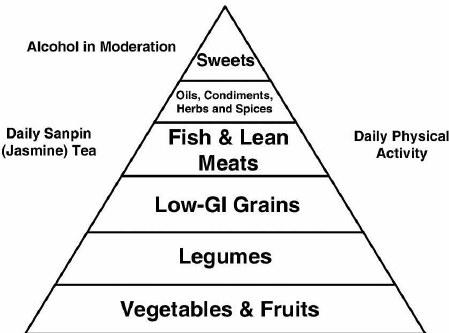
Essentially a development of the previous principle. It is important to eat heartily. The Okinawan way of eating is called Hara Hachi Bu, which means to eat 80% full, and the habit of eating antioxidant-rich foods has been established. It doesn’t actually mean getting up hungry. The idea that you have to get up from the table hungry is flawed and wrong. Look at the photos of the diets, would you really be hungry afterwards?
Yes, in general, the calorie figures for the Okinawan diet are smaller than the European ones, but once you make allowances for the weight of a Japanese and a European, there is no difference! It’s very important to eat enough, but not to overeat. That is, you could still eat, but you are already satiated. There are many factors of satiety: a lot of fibre, low calorie foods, soup at the beginning of the meal, long meal times and a number of other factors.
It takes about 20 minutes for the stomach receptors, which are sensitive to stretching and signal satiety, to realise whether you have eaten enough or more. The Japanese eat many foods in small portions. They also use chopsticks to help them eat food more slowly, giving the body more time to feel full.
For most soups, all ingredients and broth are boiled separately from each other and only combined before serving. Notably, Japanese eat soups with chopsticks, fishing out bits of vegetables and meat first. Then they drink the broth directly from the cup. Broth-based soups are served at the beginning of each meal, which has been shown in studies to help reduce the total number of calories consumed during a meal and accelerate the feeling of satiety.
Principle 4. Healthy carbohydrates
Carbohydrates are an important difference in Okinawa. They eat less rice, less wheat. There is yams to replace rice, but the noodles are not wheat noodles, but buckwheat noodles (soba). Interestingly, the Okinawan diet is generally considered to be high-carbohydrate, as carbohydrates account for 85% of the total calories consumed by the islanders. Then come proteins – 9%, and fats – 6%.
The traditional diet of Okinawans consists of 30% vegetables, mainly yellow and green colours. Rice is also present in the menu, but not in such large quantities as in other Japanese. The islanders prefer sweet potato yams to rice – it is the basis of their diet. Unlike the rest of the Land of the Rising Sun, rice did not take root here for a long time, and the real salvation for the locals was imported from Southern China. Imo is the alpha and omega of Okinawan cuisine, the main source of carbohydrates. Since long ago, when typhoons ravaged the archipelago three or four times a year, destroying rice fields and other crops, imo, hidden deep inside, survived and saved Okinawans from starvation.
Note that the relationship between our tuber and the exotic yam is not obvious. Although it is sometimes called sweet potato or American potato, it belongs to a completely different family – the tuber family. Moreover, it significantly wins in all respects. Unlike potatoes, whose tubers are edible, yams are root vegetables. In terms of useful properties, sweet potatoes compare favourably with ordinary potatoes. The yam contains about the same amount of carotene as carrots, and only half as much ascorbic acid as oranges. It also has folic acid, B vitamins, vitamin E, pectin, fibre and mineral salts. In terms of carbohydrates, calcium and iron, yams are also noticeably superior to potatoes. It also contains proteins, which ensure long shelf life. Recently, yams have been listed as an ‘anti-diabetic’ food due to their ability to stabilise blood glucose levels and reduce insulin resistance.
Principle 5: Seafood
Okinawa eats a lot of animal and vegetable seafood. They also eat fish, which is eaten on average three times a week. Squid and octopus are the most popular seafood. Most freshwater and sea fish should be marinated for about 30 minutes before grilling. The exception is fatty fish with strong flavour such as amberjack, bluefin tuna, salmon, mackerel, mullet, marlin, or even our river catfish, which can be marinated for 4 hours or more. Practice has shown that marinating oily fish longer makes it taste even better. Our Japanese-style marinade is not too acidic, as it uses citrus juice rather than vinegar, which can marinate the fish in a short time. And fresh ginger adds a distinctive look, aroma and flavour to the whole dish.
A particularly popular seaweed is kombu. Seaweed is often added to pork dishes, with which it combines well. Virtually calorie-free, rich in iron, iodine and calcium, kombu is also an excellent source of natural fibre. Other seaweeds that grow off the coast of Okinawa have similar properties: crunchy Mozuku, transparent Asa, spiny Moi sea tongue, and sea grapes. Seaweed is dried, pickled in vinegar and soy sauce, and added to soups and stews of meat, fish and shellfish. Spices are an essential element of traditional cuisine in hot and humid climates, such as Okinawa, to help prevent food from spoiling quickly.
Principle 6. Greens, vegetables and fruit
Antioxidants are derived from vegetables; very popular is the bitter goya courgette (better known as momordica), which loses its bitterness during cooking but retains a lot of useful substances. In addition, the food of Okinawans is rich in dietary fibre, which improves glucose tolerance and reduces the risk of diabetes and cancer. Also, the diet in Okinawa with low animal fat content is optimal for health, essential fatty acids omega-6 / and omega-3 have a ratio close to 1: 1. This leads to a reduction in viral epidemics, chronic heart disease, cancer, diabetes and arthritis. I should also add that this type of diet has a low glycemic index. This means that it does not cause a sharp rise in blood sugar.
The Okinawan diet includes sweet potatoes which replace rice, it is rich in leafy vegetables – spinach, leaf lettuce, basil, dill, parsley, etc., root vegetables, as well as products made from soya – tofu and miso. It also includes a lot of medicinal plants, seafood and seaweed.Note tsukemono – pickled vegetables. Each type of vegetable has its own method of pickling. Since the vegetables are not heat-treated, they retain all their nutrients. Vegetables: bamboo shoots, burdock, Chinese cabbage, corn, Japanese radish, aubergines, mushrooms, soya beans and sweet potatoes. Vegetables harvested in the mountains: “ascetic garlic”, bamboo shoots and ferns.
Principle 7. Diversity
Okinawans have an incredibly diverse menu. They regularly eat more than two hundred different foods. Vegetables and fruits are the mainstay of the diet. The most popular vegetable in Okinawa is the bitter goya melon, or nigauri, which looks like a large cucumber. Goya is a summer staple and is an effective way to combat the exhausting heat. For example, the usual diet of a European person is about 45 kinds of products per week, and the diet of the Japanese is about 100 kinds of products per week! It necessarily includes fish, vegetables and fruit. The locals call their cuisine Champura, i.e. “hodgepodge”, indeed the dishes consist of heterogeneous ingredients, far from a separate diet. But the Japanese, unlike other Asian nations, in their cuisine prefer to emphasise the natural flavour of food. That is why they use little seasoning, practically do not fry, many products are eaten raw. Despite the variety of dishes, they are served in a very small volume. Note also the use of pepper, horseradish, turmeric and ginger in substantial quantities. In Okinawa, for example, they drink a lot of green tea and turmeric-based drinks.
Principle 8. Diet and cooking
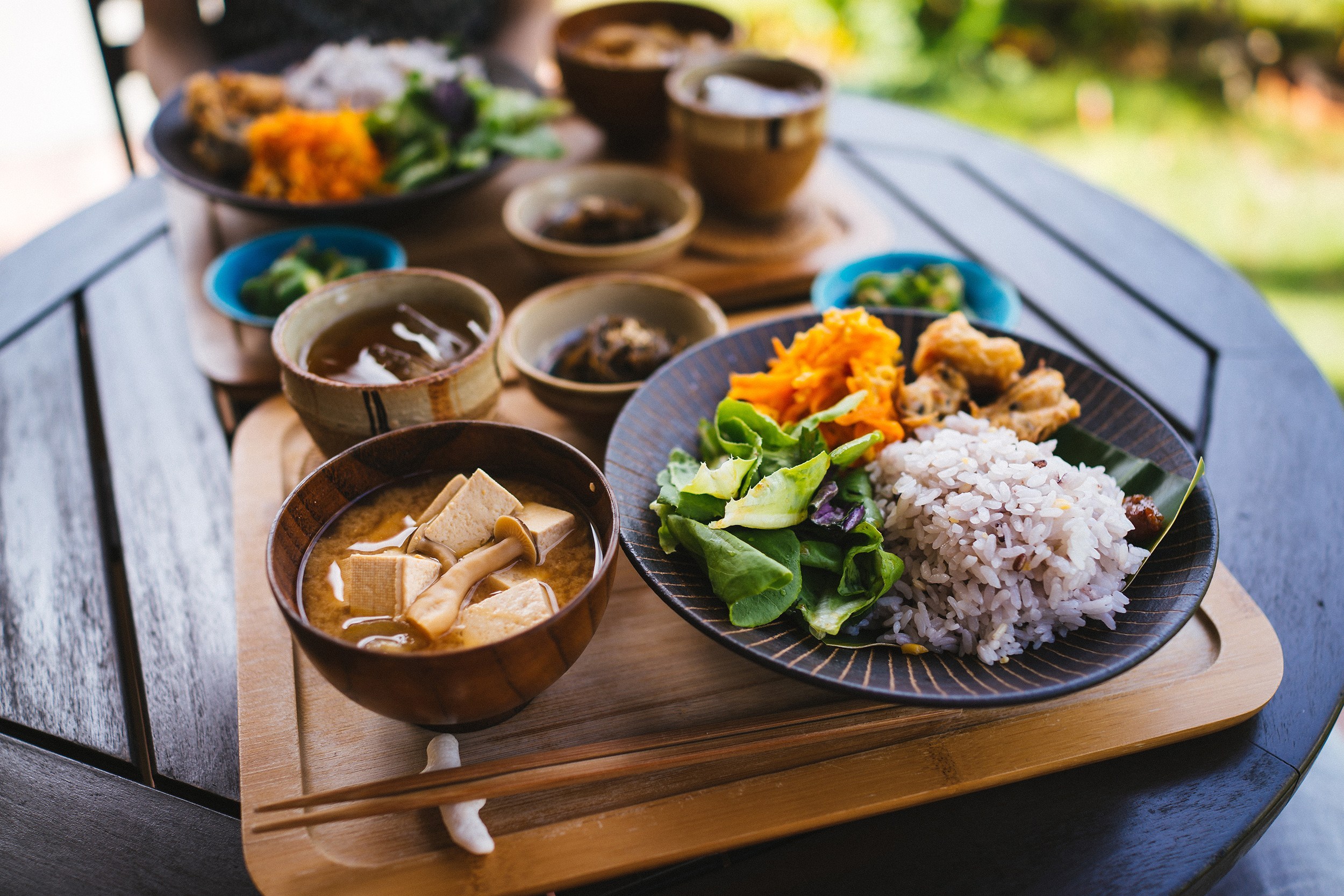
It’s simple. Three meals. I note the dense good breakfast (which, in volume, is comparable to our lunch) and the variety of food. Japanese breakfast usually includes boiled rice, miso soup with tofu, green onion and omelette, grilled fish, green tea. Of course, there are no snacks. Great attention is paid to the freshness of the food and gentle cooking methods. The photo below is an example of a breakfast. Impressive?
Principle 9. Meat and animal fats
Okinawans, unlike other Japanese, prefer fish to pork, which they eat in two polar variants: dipping raw pork fat in soya sauce – similar to sashimi – or boiling the pork until the fat melts completely. But Okinawans eat much more seaweed and soya than other Japanese, but they do not consume dairy products at all. But animal products make up no more than 20 per cent of the total caloric content of the diet.
In spite of the fact that their diet is vegetable, Okinawans eat meat with pleasure, and the main source of meat is pork – in the language of Okinawa island meat and pork are the same thing. Pigs are used in many dishes, eaten whole, with tails, ears and heels. One of the favourites is a rich soup made from pigs’ feet, from which most of the fat is removed, the healthiest part being the abundance of sticky collagen and casein, which our health food advocates regularly anathematise. In addition to meat, the island loves fish, and unlike the rest of Japan, they never eat it raw. And although meat and fish are very revered among the islanders, they are not eaten too often, the basis of the diet is still vegetable.
Principle 10. Fermented foods
You remember that microorganisms are a good thing. Fermentation is also a great friend of ours. It makes hard-to-digest foods easy to digest and increases the amount of nutrients. Why does this happen? Friendly microorganisms in the fermentation process break down complex substances into simpler ones, neutralise plant poisons, preserve, multiply and produce vitamins. Fermented soy products such as miso, tempeh, and properly prepared soy sauce are extremely beneficial. A large percentage of phytic acid is neutralised in them. Soy milk, tofu, and poor quality soy sauce should not be overused.
There are a lot of fermented foods eaten in Okinawa. Let’s mention tofu (I emphasise, specifically high-protein dense fermented tofu!). Tofu made on the island is more dense than traditional tofu. Tofu is eaten very often here, in fact it is part of every meal. The fermented miso paste is also of great importance. Miso is made from legume products that are fermented together with grains (rice, wheat) and waste products from tofu production. Barley, wheat, rice, as well as potato starch and okara – what remains after tofu is made – are used for fermentation. The fermentation process takes three to six months, so it was made two or three times a year. Almost every one of the many islands in the Ryukyu archipelago boasts its own miso.
Not just food alone
Social systems are very important for health. These are the principles of yuimaro and ikigai. The local principle is yuimaru (our talaka), which can be translated as “good-hearted and friendly co-operative endeavour”. The atmosphere of mutual help adds to the longevity of long-lived people the peace of mind and optimism so necessary to enjoy life in old age. When a neighbour needs help in the vegetable garden or fixing the roof, half the village will come to him, because, as we say, “many hands make the work easy.
Older Okinawans are involved in all community activities. Even when they come to the school stadium to cheer on other people’s children in physical education classes, that is also yuimaru. Each villager pays a small fee to our municipality to organise common activities,” Hana says with a smile. – I take ikebana and calligraphy classes, Michiko does Okinawan dance and Misako does photography. Being old allows you to try many interesting things.
It’s not just the number of years, but how the last years are lived. Villagers continue to pick at the earth almost to the grave. Long-lived people do not sit still in their free time: they have a basket weaving circle, or ikebana, or calligraphy, or karate. Men play croquet, a local form of croquet, and there are playgrounds for it in every village.
There are those who at 80 run marathons and fish by scuba diving. But most just walk, labour in the fields and participate in the community. And although older Okinawans are more likely to live alone, they are adherents of the yuimaru philosophy. Moai are a kind of interest groups uniting up to 50 per cent of Okinawans.
The principle of ikigai is what you get out of bed for in the morning. Some get up to run marathons, others to nurse their great-grandchildren, and some are driven by responsibility and pride that he or she is the oldest in the family or village. I wrote about ikigai earlier.
Published
July, 2024
Duration of reading
About 5-6 minutes
Category
Nutrition
Share

