Dopamine diseases
Dopamine is both a hormone and a neurotransmitter. Dopamine is a hormone synthesised in the adrenal cortex and is the “little brother” of adrenaline and noradrenaline. The effects of these hormones on the body are similar, but dopamine is weaker. It forces the blood vessels to narrow, the heart to beat harder, the kidneys to filter blood more actively, and the intestines to relax. The brain is not directly affected by the hormone dopamine, nor does its synthetic analogue injected into the brain. However, in most cases, when we talk about dopamine, we mean the neurotransmitter dopamine. It is the one that has gained fame as the “winner’s hormone”, and its deficiency leads to dopamine-related diseases.
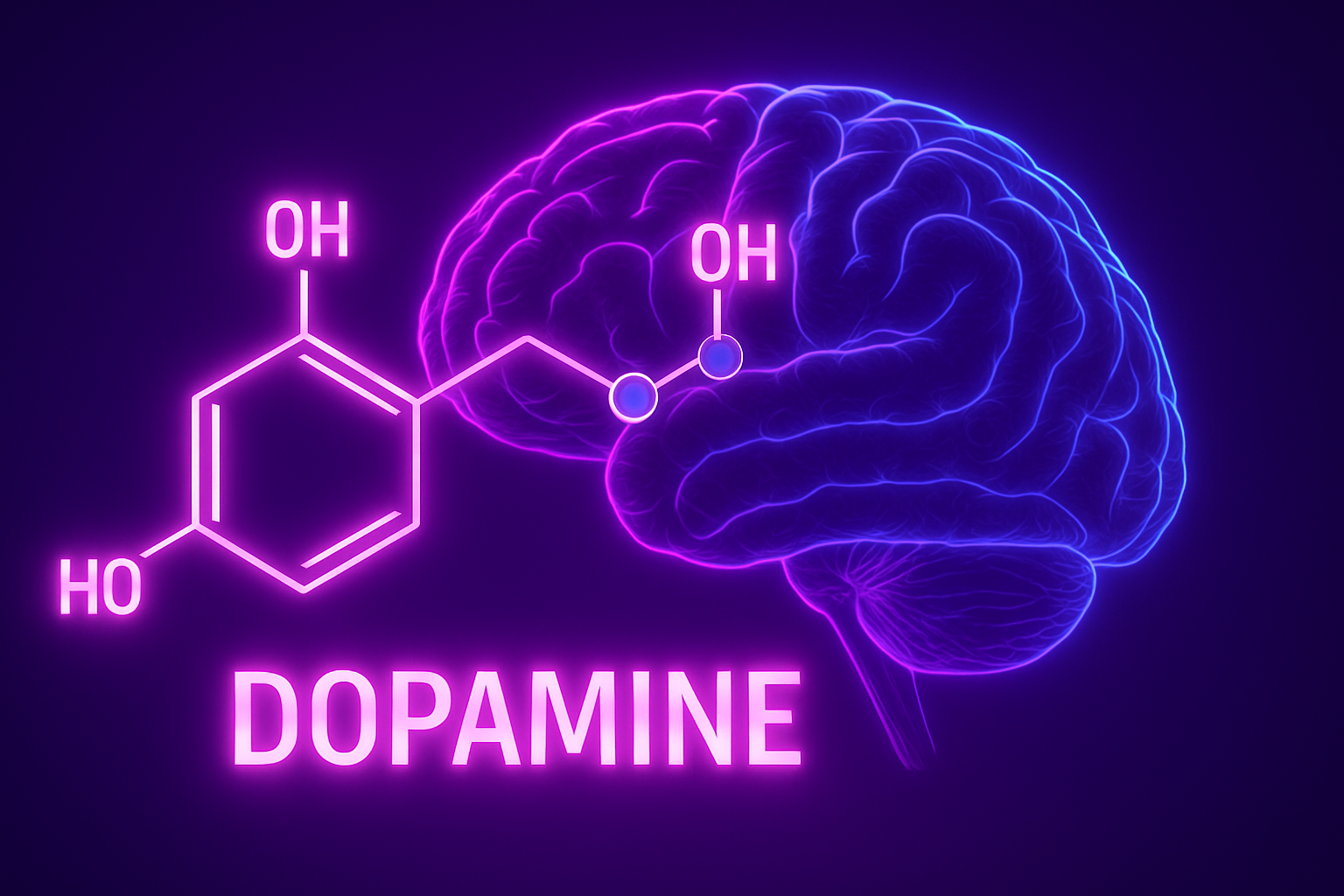
The role of the neurotransmitter dopamine in the functioning of the body
The neurotransmitter dopamine is synthesised in nerve cells and is involved in the transmission of nerve impulses. The signal from one neuron to another travels along long branch wires and is electrical in nature. However, in the place where two branches meet, the nature of the signal changes from electrical to chemical: such places where two branches meet are called synapses, and the substances released from the nerve endings that transmit information are called neurotransmitters.
The neurotransmitter that is released during the transmission of a nerve impulse determines the effect that the impulse will cause – the emergence of a certain feeling, motivation to take action. Dopamine is one of the key factors in the internal reward system. Its release leads to a feeling of joy and euphoria when moving towards a goal, and especially at the moment of its achievement.
Dopamine is produced when a person has a positive (according to subjective evaluation) experience: it can be a sexual experience, tasty food, achievement in sports, a good grade at school, monetary reward, praise from a superior, and so on. Dopamine levels increase not only at the moment of the experience itself, but also when the experience is recalled, thus fixing the pattern.
Dopamine also plays a crucial role in the realisation of cognitive processes – memory and thinking. Experiments have proved that this neurotransmitter is necessary for switching attention from one stage of cognitive activity to another. Taking into account its role in creating motivation, it becomes obvious: dopamine is very important for learning processes both at the stage of cognitive functions involvement and at the moment of getting pleasure from the result. When dopamine is deficient, both the cognitive and motivational aspects of learning suffer.
Another function of dopamine is to support motor activity, relieving muscle tension and the pleasure of physical activity. The combination of this function and motivational function makes dopamine an ideal neurotransmitter for athletes: it supports the desire to win, helping to overcome difficulties and generously “gives” a reward in the form of a feeling of euphoria when the goal is achieved.
Don’t miss the most important science and health updates!
Subscribe to our newsletter and get the most important news straight to your inbox
What are dopamine pathways?
Neurons whose nerve endings produce dopamine are found in various parts of the brain. However, in some parts of the central nervous system, whole clusters of such neurons are found, which are called dopamine nuclei that form the dopamine system. The nuclei combine to form neuronal complexes – the substantia nigra and the ventral pial area. These parts of the brain play a key role in reward and motivation processes.
The nuclei contain the bodies of neurons, and the long branches of neurons (axons) coming from the nuclei form the dopamine pathways. There are three main dopamine pathways – what do they connect?
- Mesolimbic pathway – goes from the ventral covering to the limbic system of the brain. This pathway is responsible for emotional responses and motivational processes.
- Mesocortical pathway – goes from the ventral covering to the frontal lobe of the brain: it plays a fundamental role in learning processes, as well as for emotions and desire formation.
- Nigrostriatal pathway – goes from the substantia nigra to the so-called extrapyramidal system, which regulates motor activity. This dopamine pathway is responsible for optimal muscle tone and the absence of stiffness in movement.
In addition to the three basic pathways, there is also a dopamine pathway connecting the limbic system with the pituitary gland and hypothalamus – the tuberoinfundibular pathway. In the pituitary and hypothalamus, dopamine inhibits the formation of some hormones, in particular, the hypothalamic signalling hormones somatoliberin and somatotropin, prolactin and others. In addition, there are several other “secondary” dopamine pathways – diencephalospinal, incertohypothalamic and retinal.
Dopamine diseases
As experts have studied the role of dopamine in the nervous system, they have found that a deficiency or excess of this neurotransmitter underlies some severe diseases whose nature was previously unclear, such as schizophrenia and Parkinson’s disease. What is the link between these diseases and dopamine?
Parkinson’s disease
The regulation of human movements and muscle tone is related to the functioning of a brain structure called the corpus striatum. This structure receives two types of signals. Signals responsible for sharp contractions of skeletal muscles come from the motor centres of the cerebral cortex via glutamate pathways. Impulses going to the striatum via dopamine pathways are responsible for decreased muscle tone and smooth movements. Normally, these two types of impulses balance each other out, allowing for a combination of clarity and smoothness of movement.
Parkinson’s disease is associated with the death of neurons that make up the dopamine nuclei of the substantia nigra. This neurodegenerative process is caused by the accumulation of the toxic protein α-synuclein in this area of the brain, which negatively affects the functioning of nerve cells. Disturbances affect the nigrostriatal dopamine pathway – the more cells die, the weaker the impulse along this pathway becomes. As a result, the balance between impulses travelling along the dopamine and glutamate pathways is disturbed, with the balance shifting towards the latter. This is manifested in increased muscle tone, decreased smoothness of movements, and hand tremors.
As the disease progresses, the person gradually loses the ability to perform even the simplest purposeful actions. Parkinson’s disease also causes non-muscle tone disorders: sleep disorders, digestive disorders, anxiety, and often problems with thinking, leading to dementia.
The study of the role played by dopamine in the development of Parkinson’s disease has made it possible to develop drugs that help increase the concentration of this neurotransmitter in the brain. The most commonly used drugs are those that contain a dopamine precursor: penetrating the brain, it is taken up by dopamine nuclei neurons, thereby increasing the synthesis of dopamine.
Schizophrenia
The role of dopamine in the development of schizophrenia was discovered relatively recently, in the 1950s. It was assumed that the symptoms of this disease could be associated with an excess of dopamine in the brain. To date, many studies have been conducted that have helped to reliably describe the role of dopamine in the onset of schizophrenic disorder. It has been found that some symptoms are associated with a deficiency of this neurotransmitter, while others are associated with an overproduction of it.
- An excess of dopamine in the mesolimbic pathway leads to the so-called productive symptoms of schizophrenia – delusions, visual and auditory hallucinations, paranoia (persecution mania)
- Dopamine deficiency in the mesocortical pathway leads to such manifestations of schizophrenia as apathy, lethargy, antisocial behaviour, impoverishment of speech (emotional-volitional decline), as well as to cognitive disorders – deterioration of attention and memory, executive functions.
With increasing understanding of the role of dopamine in the development of schizophrenia is associated with the emergence of drugs for its treatment. Antipsychotics that block dopamine receptors are widely used, which reduces the intensity of its effect on nerve endings. This, first of all, allows to reduce the severity of productive symptomatology – hallucinations, delusions, paranoia. New-generation antipsychotics (so-called atypical antipsychotics) also have a positive effect on the emotional-volitional sphere and cognitive functions.
The main problem with the use of antipsychotics is the development of side effects. These drugs, especially the “old” generation (typical antipsychotics), block all dopamine receptors in the brain, resulting in symptoms similar to those of Parkinson’s disease (drug-induced Parkinsonism). Atypical antipsychotics also have these negative side effects, but to a lesser extent. The development of drugs with maximally selective action on dopamine receptors in different parts of the brain is one of the most important challenges facing modern psychiatry.
Conclusion
Not only schizophrenia and Parkinson’s disease, but also a number of other disorders are associated with impaired dopamine formation. These include obsessive-compulsive disorder, characterised by obsessive compulsive states and actions; anhedonia, a condition in which a person does not enjoy food, sex, movement, social success, etc., and, accordingly, has no motivation to achieve them. The role of dopamine deficiency in the development of such common diseases as depression and dementia has also been proven. In addition, insufficient dopamine formation is associated with an increased propensity to drug, gambling, food and other types of addictions. Further study of the nuances of the formation and metabolism of dopamine in the body in the future may help to develop methods of treatment and prevention of dopamine diseases.
Published
June, 2024
Duration of reading
About 3-4 minutes
Category
Brain and nervous system
Share

