A placebo for everyone
Everyone knows what a placebo is. It is a substance without medicinal properties that is given to the patient instead of a real medicine, and in some cases he reacts to this pacifier as an effective drug. This response is called the placebo effect, and it is also well known and described in detail. Theoretically, the placebo effect could be used for treatment, the question is how useful and safe it is. In addition, the effect has not yet been sufficiently studied to be controlled; it is difficult to investigate it, if only because the main object in this case is a person, and it is not always ethical and almost always expensive to conduct such experiments on humans. Therefore, a model object is needed.
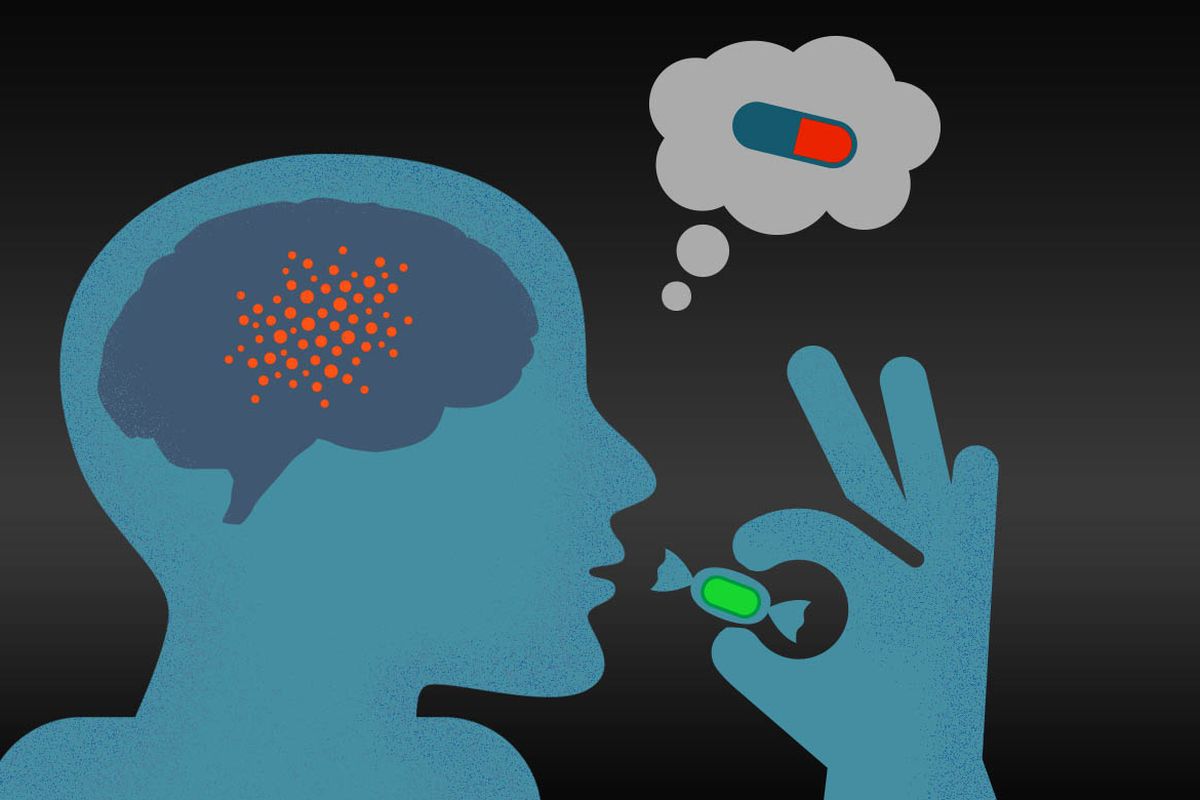
Fortunately, placebo-like effects are common in all animals, even as simple as the soil nematode Caenorhabditis elegans and Drosophila melanogaster. At first glance, this is strange, since a significant part of the placebo effect is a psychological factor, and it is difficult to inspire anything to the nematode. The explanation of this paradox was proposed by scientists at Christ Church University of Canterbury (UK), Dr. Simon Harvey and Professor Chris Beady. Researchers believe that placebo effects represent cases of phenotypic plasticity (Biology Letters, 2017, 13, 20170585).
Phenotypic plasticity is the ability of an organism to change its appearance, physiological state, or behavior depending on environmental conditions. Thanks to it, individuals with the same genotype look or behave differently in different environments. However, the British researchers are probably referring to the conditioned reflexes of the body, its reaction to certain key indirect signals. For example, such a key incentive as food. When the animal eats, the concentration of glucose in the blood will change, which will lead to a cascade of certain biochemical reactions. It is a direct response to change or, as we were taught in school, an unconditional reflex. And it happens that the animal has not eaten anything yet, just smelled the smell, and its digestive system is already ready. This is a conditioned reflex— the body’s response to a promise stimulus, which Harvey and Beady called phenotypic plasticity. It can be likened to the behavior of a person who, having seen clouds in the sky, takes an umbrella with him, although it is not raining yet. We will stick to the terminology of the researchers. They note that the ability to anticipate future changes and prepare for them in time is vital, organisms that did not possess it died out a long time ago. So phenotypic plasticity is a very ancient adaptation inherent in all multicellular organisms.
However, the placebo effect is a reaction to a false stimulus: the smell of food implies a close meal, and a starch pill does not promise relief. According to Simon Harvey and Chris Beady, this effect arose due to the ability of Homo sapiens to change the environment and create false signals. The person already has some experience of treatment, he is used to the pill helping. After receiving a placebo, the body does not react to it as a harbinger of healing. Such a reaction can be caused by many factors: trust in the doctor, previous experience (last time such a yellow pill helped a lot), hope, anxiety. Fabrizio Benedetti, a professor at the Medical University of Turin who has devoted many years to the study of placebos, called this situation a new physiology of the doctor—patient relationship (Physiological Reviews, 2013, 93, 1207-1246). The patient lives in a difficult environment, and doctors play a special role in it, since the patient looks at his illness through their eyes (see Figure 1). Doctors are advised to talk with patients, talk about the success of treatment, and inspire hope.

Pic. 1. The placebo effect is determined by environmental factors surrounding the patient
The current state of neuroscience makes it possible to find the biological basis of human emotions. During the placebo effect, the same processes occur in the body that accompany the action of the drug, they involve dopamine, opioid and cannabinoid receptors. These physiological changes can be recorded and measured.
If the placebo effect in humans is a biological reality, then it should have arisen as a result of selection and provided some kind of advantage. For example, to help a person endure pain, depression, or muscle fatigue. It would seem that these are all subjective feelings that could not become a target for selection. However, there are cases when sensations are accompanied by objective changes.
Fabrizio Benedetti et al. investigated the effect of placebo on people suffering from hypoxia at an altitude of 3500 m (Pain, 2015, 156, 2326-2336). The subjects complained of headaches and quickly tired of physical work, which was accompanied by a decrease in prostaglandin levels in saliva, oxygen in the blood, and palpitations. Inhalation of pure oxygen normalized these indicators. A placebo (an empty balloon attached to an oxygen mask) helped to get rid of fatigue, but not from headaches. However, after the subjects were given oxygen twice, the placebo relieved them of pain, as well as normalized prostaglandin levels and heart rate. At the same time, the oxygen content in the blood remained low. The researchers concluded that fatigue is more sensitive to the placebo effect than headache, and the placebo effect occurs after training.
Another case is Parkinson’s disease, which is accompanied by changes in neural activity and decreased levels of dopamine in certain parts of the brain. Professor Benedetti gave the patients a placebo and did not notice any changes. But in patients who had previously taken apomorphine, which increases dopamine levels, the placebo effect mirrored the effect of apomorphine.
The placebo effect is not limited to medicine. Nutrients that are present but not consumed can also deceive a person. So, athletes show better results if they first rinse their mouth with a glucose solution without swallowing it. Caffeine rinsing has a similar effect. Obviously, the body anticipates the intake of caffeine or glucose into the body, because once in the mouth, they are about to enter the intestines in a natural situation.
If the placebo effect is the result of phenotypic plasticity, it should also occur in other animals, especially when the upcoming environmental changes are detrimental to them. Indeed, back in 1975, specialists from the University of Rochester (USA) gave rats the immunosuppressive drug cyclophosphamide along with saccharin. Three days later, sheep erythrocytes were injected into the animals. The rats’ immune system produced antibodies to them. Cyclophosphamide suppressed the production of antibodies, as well as the intake of saccharin. The body has associated this taste with an immunosuppressor. In another study, rats accustomed to morphine were injected with one tenth of the normal dose, and it acted as a full-fledged painkiller.
In invertebrates, such an effect, that is, a response to a promise stimulus, has also been found. The easiest way is to study their reactions to food. By reducing the total calorie intake, but retaining the necessary amount of trace elements and vitamins and avoiding exhaustion, it is possible to increase the life expectancy of C. elegans and drosophila by one and a half times. However, in both species, the calorie restriction effect is blocked if they smell food (Fig. 2). The body believes a deceptive stimulus that promises food. The smell of food in this case acts as a placebo, or more precisely, as a nocebo, that is, a negative response to a pacifier.

Pic 2. Placebo even works on the worms Caenorhabditis elegans. Temporary starvation prolongs the life of nematodes, but the smell of food blocks this effect.
A similar effect has been found in nematodes under cold stress. Worms die if they are kept at temperatures below 5 ° C for a long time, but mortality decreases markedly after hardening at a low temperature, but not stressful. A similar effect is achieved by the destruction of specific cold-sensitive neurons. Thus, survival is based not on the actual temperature, but on sensitivity to it. It is the perception of temperature, that is, the signal coming or not coming from neurons, that affects the biochemical pathway that regulates life expectancy.
So, both worms and flies react to a deception, an unfulfilled promise. This is the placebo effect, and it depends on the effect on certain neurons.
The biology of the placebo effect may have significant clinical and scientific significance. It is necessary to find out how and on which systems it is necessary to influence it to arise, and what are the mechanisms of its implementation. Naturally, it is more convenient to study the placebo effect using simple models that will help clarify the mechanisms of action of this effect in humans. Simon Harvey and Chris Beady suggest starting the research by testing their own hypothesis. They believe that a placebo-like effect is a common response to standard environmental stimuli for all organisms, meaning that responses to a certain type of exposure should be similar in different animals. The effect will manifest itself in life-critical situations, such as lack of energy or temperature effects. During learning or evolution, the ability to respond to new stimuli develops, however, in order for an effect to occur, the impact of these stimuli must be close to the threshold of survival.
According to the authors of the hypothesis, it can be tested during experimental evolution in model systems. The test will allow you to determine the levels of stimuli needed to get a certain response. The same hypothesis will provide an opportunity to double-check the placebo effects that have already been described for humans.
Natalia Reznik, Candidate of Biological Sciences
Don’t miss the most important science and health updates!
Subscribe to our newsletter and get the most important news straight to your inbox
Published
July, 2024
Duration of reading
About 3-4 minutes
Category
The placebo
Share

