Death as a sociocultural phenomenon
At all times, the human mind has sought to comprehend the problem of death: there is an experience of understanding it in mythology, religion, philosophy and art. Most of all, people were interested not in the procedural, but in the mysterious side of this phenomenon, the “dialogue” of a person with death. The ancients initially considered dying to be the natural end of life and did not perceive it with fear or rejection. This emotional content of the problem was formed during the evolution of mythological consciousness. This is noted by F. Aries, in his theory of the five stages of death perception (from “tamed” to “inverted”).
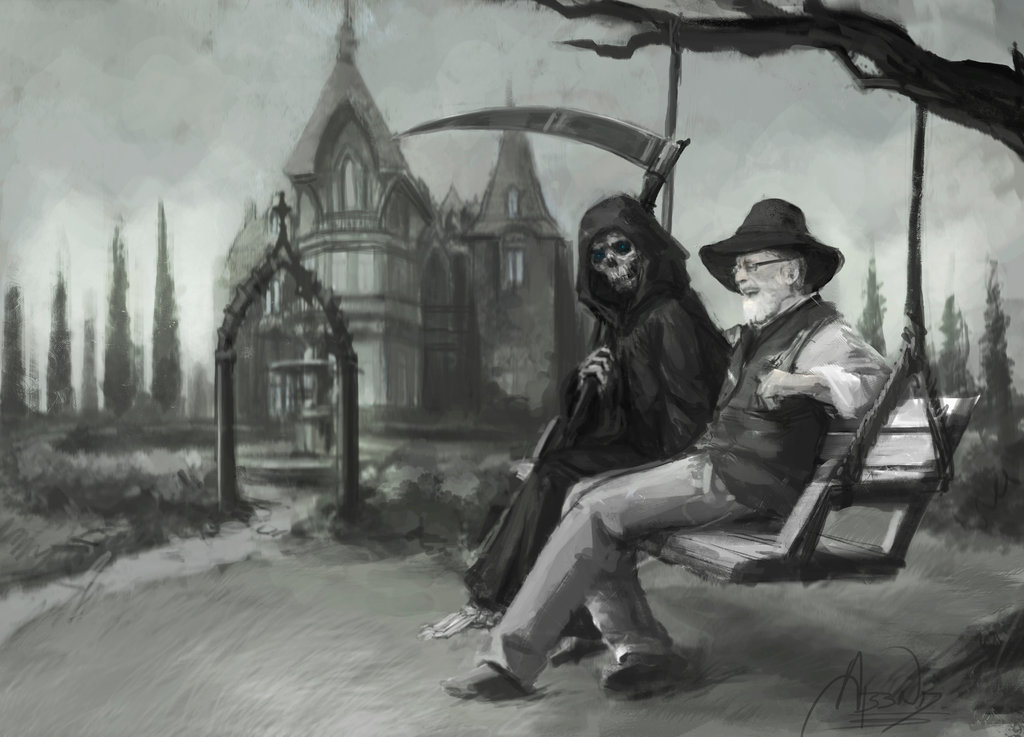
In archaic cultures, the practice of impersonating and “deceiving” Death is well known (for example, during epidemics, entire families pretended to be dead so that Death would look into their house and think that it had already been here and bypassed this place). As protection and amulet, people often carried with them the attributes used in funeral rites.
All peoples have myths related to the image of death, explaining its origin in one way or another (Thanatos among the Greeks, Mara, Karachun among the Russians, Hel among the Scandinavians, Ium-tsek, Kannich among the Maya). Depending on religious beliefs, death was understood in different ways. In antiquity, ordinary people (mortals) were distinguished from immortal gods. Christians perceived death in the context of “salvation”, “overcoming death”, and “immortality”, believing that it was bliss beyond the grave that “formed the basis of religious hope” [1]. The Scandinavians attributed this to the death of the entire world as a result of the battle of the gods with Chthonic monsters [2]. The mythology of the Indians of Central America (including the Maya) considered the afterlife of a person as a result of his inner courage and fearlessness; the deceased had to go through many obstacles before he could count on a place in one of the nine hells [3].
The phenomenon of death was present at various levels in all natural life cycles (annual labor, agricultural work, initiation rites, etc.), for this reason, the end has always been closely associated with the idea of the beginning, “resurrection.” The proto–plot of the most famous myth to mankind, about Jesus Christ, is the Old Testament story of Jonah’s sojourn “in the belly of the whale for three days and three nights” (Matt. 12; 40). The legend of the swallowing and subsequent regurgitation of the hero by a monster is very common in traditional cultures. This theme can be traced in the Finno-Ugric “Kalevala” (sage Vainamainen was swallowed by the daughter of Tuoni, the main deity in the kingdom of the dead), Finnish mythology (the blacksmith, in order to marry his beloved, has to go through the teeth of a terrible witch), Polynesian myths (the hero of Maui is eaten by his grandmother at Night: Polynesians believe that the death of this character made human mortals). A similar plot is present in the initiation rituals of some regions of New Guinea, Sierra Leone, Liberia, etc. There is a tradition of ritually placing an initiated person in a structure resembling a crocodile, whale or fish. As we can see, there is a “common theme of death followed by resurrection for all initiations” [4]. In this case, it is appropriate to talk about a double symbolism: on the one hand, the monster swallowing the heroes symbolizes death (its belly is the underworld); on the other, “descent into the belly of the monster means a return to a preformed, embryonic state of existence” [7].
The close connection with the motives of death is indicated, first of all, by the transitional nature of initiation rites (entry into adulthood, transformation into a full member of society, marriage, etc.). Like death, at this transitional moment, a person is “destroyed in his old capacity” [5], “liquidates the past and puts an end to one existence in order to start again, being reborn in another” [6]. The transition is possible thanks to intermediaries, their function is to ensure the development of the initiation process, to mix their own and others at the moment of the ceremony. This temporary state of chaos helps to renew the world, promotes the elevation of the initiated person to a new quality (spouse, priest, shaman, etc.).
In general, it is known that at all times any team has singled out people who have the ability to communicate with the other world, entering the sphere of the alien. According to A. K. Bayburin, the belonging of ritual specialists to two worlds at once was indicated by the fact that they always lived on the periphery of cultural space (river, outskirts), possessed a special appearance, specific attributes of clothing and a different manner of behavior from others. Such specialists included not only shamans, sorcerers, and healers, but also millers, potters, and blacksmiths – people who “consorted with evil spirits” because of their craft. Such an attitude towards blacksmiths is an example of reverence for Svarog, the heavenly blacksmith who “cooked up” (created) our entire world. Some animals, such as crows, were also considered messengers from another world.
In the Russian folk tale, the intermediaries between the world of the dead and the living were fantastic creatures. A striking character of this kind is Baba Yaga. She is distinguished from an ordinary fairy–tale witch by the presence of a bony (dead) leg; other sources indicate an oblique (blind) eye – the ability to see the “other” world with it. Baba Yaga’s place of residence is the edge of the forest (as mentioned, any outskirts in traditional cultures were considered a window to another world), a hut on chicken legs (as if in a “suspended state” – neither on the ground nor in the air). It was difficult to get to Baba Yaga, but since she possessed secret knowledge, the hero’s trials on the way and when meeting her were always the key to his victory over evil spirits and return unharmed.
In many cultures, death was perceived as liberation from earthly blindness, gaining the opportunity to comprehend the mysteries of the world. These ideas were often based on religious beliefs. Almost any religion says that death is the end of the existence of the body, but not the soul. Thus, Christianity and Islam affirm the existence of Hell and Heaven; the pagan faith of the Slavs, like a number of Eastern religions (for example, Hinduism), defends the idea of reincarnation, an evolutionary rebirth after death; some religious and mystical teachings (Kabbalah) see as their main goal the preparation of a person for the end of life.
The problem of death is one of the key ones in philosophy, the subject of close attention of Plato, Epicurus, Schopenhauer, Nietzsche, Freud, Aries, etc. The attraction to this subject, the pronounced interest in mysticism in the art of the Romantic era, and the cult of the sensual experience of personality led to the idea of “fascination with death” and its perception as a reward (S. Coleridge, J. Keats, W. Blake, E. Poe, and others). In the second half of the 19th century, the work of S. Baudelaire (“The Flowers of Evil”).
Postmodernists consider death as “a social phenomenon requiring rational perception and comprehension”, since modern man is “postulated in the world by awareness of his own mortality” [7]. In the 20th and early 21st centuries, such “death singers” as Haruki Murakami (the author of numerous literary works imbued with suicidal themes) and Tim Burton, the “icon” of the Gothic subculture, found a way to positively present this problem in the films “Beetlejuice” and “Corpse Bride.”
In T. Burton’s films, called “pleasant films about death” by screenwriter M. McDowell, the characters who find themselves “on the other side of good and evil” appear happy and carefree. The corresponding concept is conveyed in the color scheme: real life looks almost “black and white”, and bright saturated colors are used in scenes of the afterlife. This approach to the problem is typical of the entire modern Gothic tradition. In most cases, Burton portrays death with a certain dose of humor (laughter is one of the ways to deal with fear). This director compares the essence of his films with the symbolic content of the Halloween holiday.: “It can be scary, but it’s also funny. No one is going to scare someone to death. On the contrary, they want people to enjoy their fright” [8].
Musical art (especially in the last third of the 20th century) is also marked by a growing interest in the idea of death. This is reflected in the tendency to create so–called in memoriam – works focused on expressing sorrow and bright memory for the departed. Such music occupies a large place in the works of A. Schnittke, G. Kancheli, Y. Falik, S. Slonimsky, Y. Butsko and others. As T. Andrushchak points out, such music, denying the subjectivity of experience, “becomes an affirmation of the cleansing, harmonizing meaning of grief and a life-affirming optimistic worldview” [9].
This indicates that the theme of death in mythological, religious consciousness and in art can have the symbolism of the frightening, tragic or happy, beautiful. Any of the approaches is organic if the ethical side of the issue is not violated. At the same time, it is important that the most significant thing is not the gloomy negative idea of death, but the understanding of it as an integral part of life.
Author: Rylskaya T. P.
Source: Cyberleninka
Photo: pr0gramm.com
Don’t miss the most important science and health updates!
Subscribe to our newsletter and get the most important news straight to your inbox
Published
July, 2024
Duration of reading
About 1-2 minutes
Category
Social Psychology
Share

