The inner demon: why do we have terrible thoughts?
It’s a good thing there’s no mind-reading device yet, otherwise any of us would have been caught red-handed. After all, even the meekest and most delicate person can sometimes rejoice at the failure of a neighbor or feel the desire to smash someone’s head in. Why are good citizens happy to watch dismembered thrillers, while ardent liberals sometimes catch themselves on xenophobia? And is it possible to prevent such “thoughtcrimes”? Jena Pinkott wrote about this on the Psychology Today website, and T&P translated the main theses.
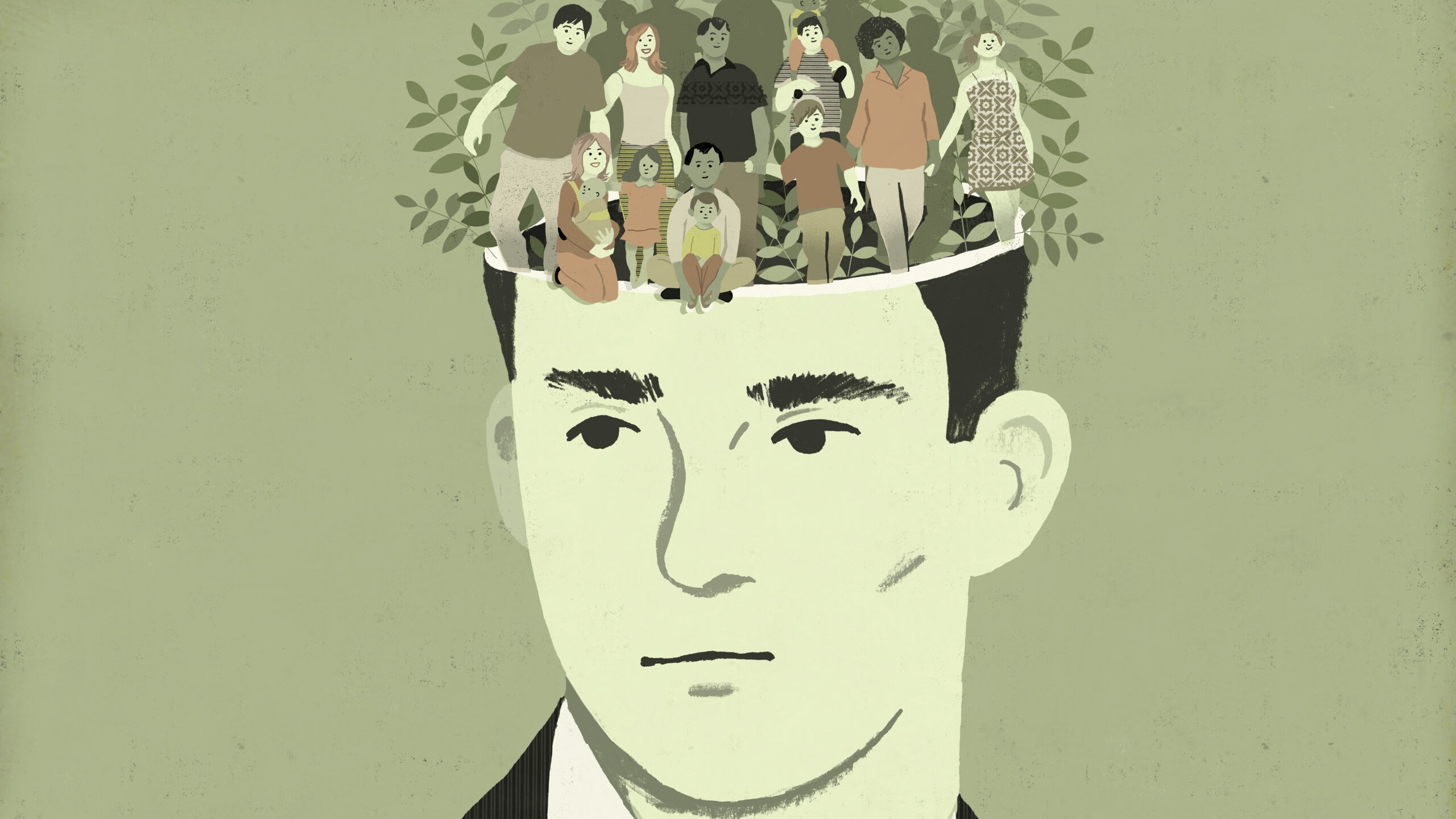
Each of us sometimes finds ourselves having wrong, frightening, or vile thoughts. Bend over a cute baby and suddenly think, “I can easily crush his skull.” To comfort a friend who has suffered a breakdown in his personal life, and secretly savor the humiliating details of his story. Driving with relatives in the car and imagining in detail how you lose control and drive into the oncoming lane.
The more we try to distract ourselves from these ideas, the more intrusive they become and the worse we feel. It’s not easy to admit, but we really enjoy the primitive thrills and misery of others. People are amazingly bad at controlling their own black thoughts: we have no control over their duration or content.
In the 1980s, in his famous experiment, Eric Klinger asked volunteers to record their thoughts for a week every time a special device beeps. The scientist found that during a 16-hour day, a person is visited by about 500 unintentional and obsessive ideas, lasting an average of 14 seconds. Although most of the time our attention is occupied with everyday activities, 18% of the total number of thoughts cause discomfort to a person and are marked as bad, evil and politically incorrect. And another 13% can be described as completely unacceptable, dangerous, or shocking, such as thoughts of murder and perversion.
Swiss psychoanalyst Carl Jung was one of the first to become seriously interested in black thoughts. In his work “Psychology of the Unconscious” (1912), he described the shadow side of personality — a receptacle of sinful desires and animal instincts that we usually suppress.
How is the dark side of personality formed? From the point of view of neurobiology, part of cognitive processes forms the “I” with which we are accustomed to identify ourselves — reasonable, normal, logical — while other processes serve as an impetus for the development of a dark, irrational consciousness, where obsessive images and ideas are born.
According to Klinger’s theory, the ancient preconscious mechanism in our brain is constantly looking for potential sources of danger in the world around us. Information about them, bypassing consciousness, is transmitted in the form of emotional signals that cause unwanted thoughts. Neuroscientist Sam Harris believes that these thoughts are random and completely uncontrollable: although a person has consciousness, he cannot fully control his mental life.

Dark and frightening thoughts
“This is disgusting, show me more”
People are embarrassed to admit that they are attracted to sinister and vile stories.: It is believed that this is the lot of freaks and perverts. Fans of bloody thrillers, photo collections with victims of road accidents or pickled embryos have a reduced ability to empathize. Thirty years ago, Marvin Zuckerman, a professor at the University of Delaware, determined that some people are more susceptible to thirst for thrills than others. When confronted with something abnormal and terrible, people with this type of personality become more aroused – this can be determined by measuring electrothermal activity.
Craving unhealthy and creepy things can also be beneficial. According to psychologist Eric Wilson, thinking about the suffering of others allows us to neutralize destructive emotions without harming ourselves and others. They can even lead to a state of awe: “I can feel the value of my own life in a new way,” Wilson writes, “because I myself and my family are alive and well!”
Thoughts about sexual perversion
“Do not open at work… or anywhere else”
Many of us consider thoughts related to sexual taboos to be the most disgusting: there is nothing worse than catching ourselves fantasizing about something immoral or illegal.
The good news is that mild arousal doesn’t mean anything. Clinical psychologist Lee Baer, a professor at Harvard University Medical School, argues that arousal is the body’s natural response to attention: “Try to think about your genitals and convince yourself that you don’t feel anything.” If you have a fleeting thought about rape or sex with a minor, this does not mean that you are going to bring this idea to life. All people think about sex, but not all fantasies should be taken literally.
Women’s erotic fantasies of submission and rape have their own logical explanation. Researchers at the University of North Texas have found that 57% of women have ever felt aroused by fantasizing about a violent sexual act with themselves as a victim. This can be explained by a woman’s desire to be desired — so much so that a man cannot control himself. Another explanation is the rush of endorphins, which enter the bloodstream more actively due to the accelerated heartbeat that accompanies feelings of fear and disgust. An imaginary situation of coercion allows you to give freedom to secret “vicious” desires without feeling guilty. Rape fantasies, which remain under the reliable control of our consciousness, have nothing to do with the desire to be raped in real life.

Politically incorrect thoughts
“If they find out what I’m thinking, they’ll hate me.”
A hateful voice in your head that turns on when an “other” appears in your field of attention — whether it’s a man in a wheelchair, a woman in a veil, a brightly dressed transsexual, or a foreigner with an unusual skin color. This voice, which you do your best to drown out, calls into question the adequacy, behavior, abilities, and generally the presence of human qualities in “others.”
Mark Schaller, a psychologist at the University of British Columbia, believes that such thoughts are caused by a primitive defense mechanism formed at the dawn of mankind, when outsiders were by definition a source of threat. However, the mechanism of “psychological immunity” does not justify modern manifestations of intolerance such as fat shaming, xenophobia, religious prejudice or homophobia.
The good news is that automatically occurring politically incorrect thoughts can be overcome: psychologists advise you to stop thinking about how polite and unbiased others consider you to be, and focus on the personality of the person you are communicating with.

Malicious thoughts
“Your failure is my joy”
When we hear on the news that some girl was caught drunk driving and arrested, it doesn’t bother us. But if this girl turns out to be Paris Hilton, we feel a strange malicious satisfaction, which the Germans call “shadenfreude” (literally “joy from harm”).
Australian psychologist Norman Feather (Flinders University) has proven that we are more pleased with the failure of someone outstanding than the failure of someone of our equal status. When successful people stumble, we feel more intelligent, visionary, and confident.
Perhaps this is how our inner desire for justice manifests itself. But where does the feeling of shame come from? According to Professor Richard Smith, author of The Joy of Pain, there is no point in beating yourself up for this banal emotional reaction. To overcome an attack of schadenfreude, you need to imagine yourself in the victim’s place or focus on your own achievements and virtues, because the best antidote to envy is gratitude.

Cruel and bloodthirsty thoughts
“If I had a chainsaw now…”
You’re calmly chopping onions in your kitchen, and suddenly a thought flashes through your head: “What if I stab my wife?” If thinking about murder were considered a crime, most of us would be found guilty. According to psychologist David Bass (University of Texas at Austin), 91% of men and 84% of women have ever imagined pushing a person off a platform, suffocating their partner with a pillow, or brutally beating a family member.
The researcher offered a radical explanation: Since our ancestors killed to survive, they passed on to us a predisposition to murder at the genetic level. Our subconscious mind always stores information about murder as a possible way to solve problems related to stress, power, limited resources, and security threats.
However, in most cases, thoughts of violence do not precede actual violence, but rather block it. The heartbreaking pictures that the brain paints force us to analyze the situation before acting. The scenario plays out in the imagination, the prefrontal cortex turns on, and the creepy thought disappears.
But what happens to dark thoughts when we suppress them?

The Hydra Dilemma
“The method of radical acceptance…”
The thoughts that we try to suppress become obsessive. It’s like fighting the Lernaean hydra.: instead of a severed head, new ones grow back. When we try not to think about something, we only think about it. The brain constantly checks itself for the presence of a forbidden thought, and it pops up in consciousness over and over again, while feelings of shame and self-loathing distract us and weaken our willpower.
The painful process of suppression can be aggravated by depression and stress. The more effort we spend fighting the obsession, the more time we need to recover and rest. For people suffering from obsessive-compulsive disorder, dealing with unwanted thoughts can take several hours a day. None of us can fully control our consciousness. As Carl Jung wrote, we do not control the shadow self, we do not create dark thoughts and desires of our own free will, and therefore we cannot prevent their appearance.
Dr. Baer recommends the Buddhist method of radical acceptance: when an undesirable idea appears, one should try to perceive it as just a thought, without deep meaning and hidden meaning. Don’t judge yourself or resist — just let the thought go. If she comes back, do it again.
Another way to let go of an obsession is to write it down on paper and destroy it. This helps to distance yourself from an unpleasant thought, and then literally get rid of it. The “door effect” can also work — physically moving to another room helps the brain switch to a new topic and reset short-term memories. For difficult cases, there is a radical approach: do not let go of frightening thoughts, but, on the contrary, replay them in your imagination in all the details to the end.
What is really important about dark thoughts? The importance we attach to them. We can perceive unpleasant thoughts as valuable objects for research — hints that the shadow self gives us. By analyzing its manifestations, we better understand others and ourselves. A dark, nasty and uncomfortable thought becomes a source of inspiration. As Eric Wilson writes, people with a developed imagination can turn destructive ideas into fuel for mental and emotional development.
The father of analytical psychology, Carl Jung, kept a diary, which was later published as The Red Book. In his diary, Jung recorded disturbing images and ideas from the unconscious, including his encounter with the metaphorical Red Horseman. The presence of a Horseman is unpleasant for Jung, but the researcher enters into a dialogue with a stranger: they talk, argue and even dance. After that, the scientist experiences an extraordinary surge of joy, feels at peace with himself and the world. “I’m sure this red man was the devil,” Jung writes, “but he was my own devil.”
Don’t miss the most important science and health updates!
Subscribe to our newsletter and get the most important news straight to your inbox
Published
July, 2024
Duration of reading
About 3-4 minutes
Category
Conscience
Share

