Non-Euclidean geometries

American author and science explorer Clifford A. Pickover explains non-Euclidean geometric systems.
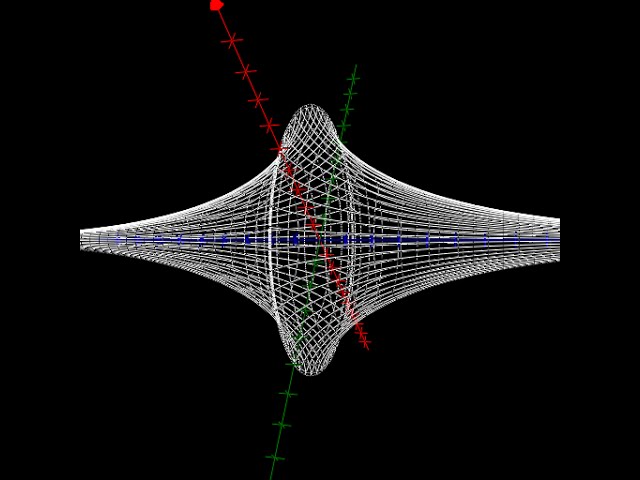
 

Non-Euclidean geometries
Since Euclidian times (ca. 325 BC— ca. 270 BC) it seemed that so-called parallel postulate is describing our three-dimensional world adequately. According to this postulate, in a plane through a point not lying on a given line, only one line can be drawn, which will never intersect with the given line. The creation of systems of non-Euclidean geometry in which this postulate is not observed has led over time to colossal consequences. Einstein said the following about non-Euclidean geometry: ‘I attach special importance to the view of geometry which I have just set forth, because without it I should have been unable to formulate the theory of relativity.’ Essentially, in Einstein’s general theory of relativity, spacetime is a non-Euclidean geometric system in which space-time is deformed or warped near gravitating bodies such as the sun and planets. And so does it happen: imagine placing a bowling ball on a thick sheet of rubber. If you then place a small marble in the resulting depression and push it, for a time the small marble will orbit the bowling ball, much like the planets orbit the sun. In 1829, the Russian mathematician Nikolai Lobachevsky published his work “On the Principles of Geometry”, in which he presented a fully consistent geometric system based on the proposition that the parallel postulate is false. A few years earlier, the Hungarian mathematician János Bolyai had developed a similar non-Euclidean geometry, but his results were not published until 1832. In 1854, the German mathematician Bernhard Riemann summarised the findings of Bolyai and Lobachevsky by showing that, given the appropriate number of dimensions, different non-Euclidean geometries could exist. Riemann once remarked, ‘The value of non – Euclidean geometry lies in its ability to liberate us from preconceived ideas in preparation for the time when exploration of physical laws might demand some geometry other than Euclidean.’ With the advent of general relativity, this prediction had come true. Source: Pickover, C. “The Math Book” Photo: i.ytimg.com

Don’t miss the most important science and health updates!

Subscribe to our newsletter and get the most important news straight to your inbox

Published

July, 2024

Duration of reading

About 1 or 2 minutes

Category

Math

Share

Send us a message