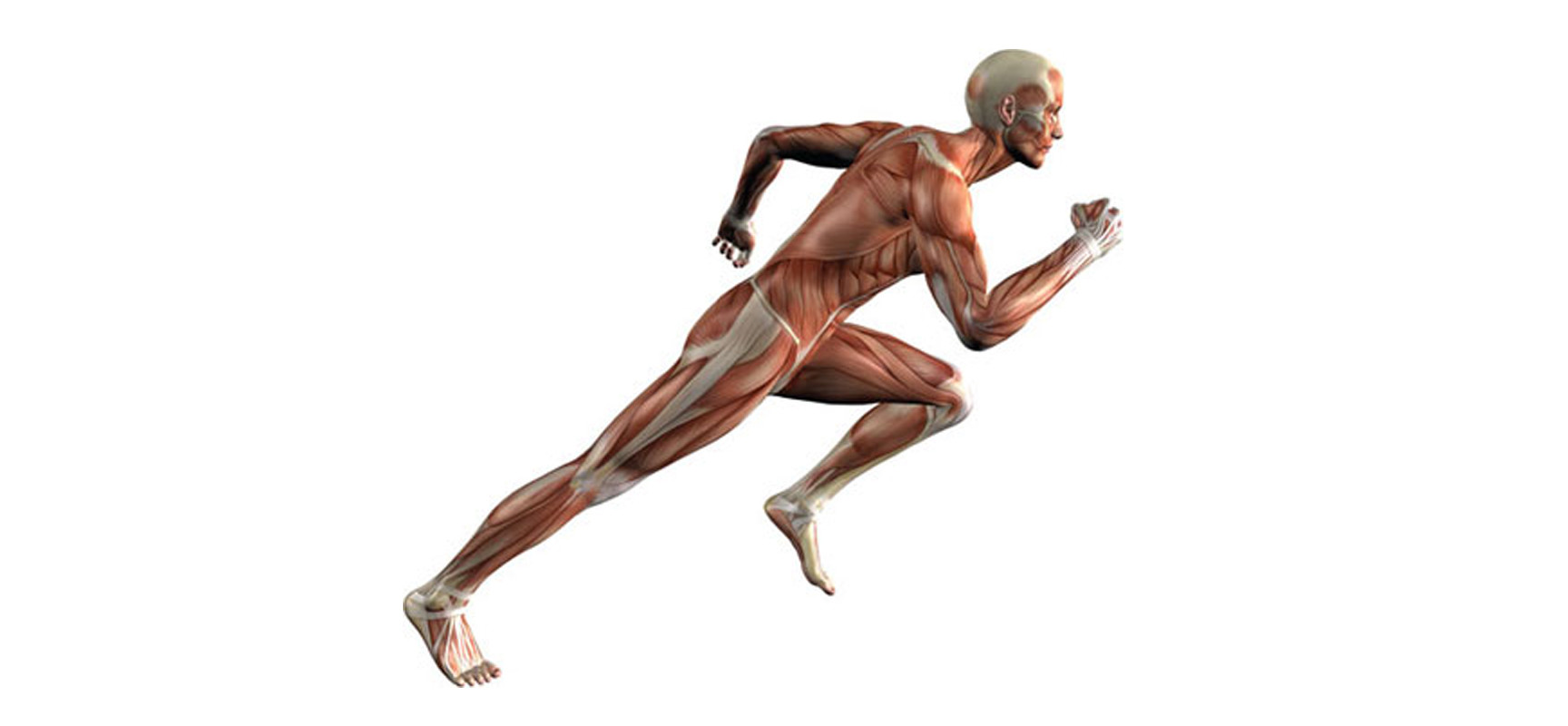
Muscles cover joints and bones, and the shape of the body depends on them. The muscular system makes up a significant part of the total human body weight. In newborns, the mass of all muscles is 20-25% of body weight, in the elderly about 25-30%. At the age of 17-18, the mass of all muscles reaches 30-35% in girls and 40-45% in young people. In athletes with well-developed muscles, it can account for up to 50% of body weight. Over the entire period of the child’s growth, the mass of muscles increases 35 times. The muscles of a child are more elastic than those of an adult. During puberty (12-16 years old) along with the elongation of the tubular bones, the muscles also lengthen intensively. Teenagers at this time look long-legged and long-armed. By the age of 12-14, the muscle-tendon relationships characteristic of the muscles of an adult are established. Muscle development lasts up to 25-30 years. In an adult, 50% of the total muscle mass is in the lower extremities, 30% in the upper and only 20% in the muscles of the head and trunk. With the same volume, muscles are heavier than fat and are able to hold 60% more water.
In a muscle, the middle part is distinguished — the abdomen, consisting of muscle tissue, and the tendon, formed by dense connective tissue. The muscular part has the ability to contract and relax. The tendon does not contract, but only transmits the action of the muscle. Tendons are used to attach muscles to bones, but some muscles can also attach to various organs, such as the eyeball, and some muscles of the face and neck attach to the skin. Many muscles surround the body cavities and protect the internal organs. Muscle function, like rest, is regulated by the nervous system. The blood supply to the muscles is provided by the arteries. The arteries, entering the muscles, branch to capillaries, which form a dense network in bundles of muscle fibers. One square centimeter of muscles is filled with 500 capillaries.
To take a step, a person needs to use 200 muscles. In fact, this number may be slightly higher or lower depending on how the load is distributed during walking and other unique anatomical features.
The structure of the muscles is divided into striated (voluntary) and smooth (involuntary). Striated skeletal muscle tissue consists of numerous muscle fibers, which are elongated cylindrical formations with pointed ends ranging in length from 1 to 40 millimeters (and according to some sources — up to 120 millimeters) and a diameter of one millimeter. The name “striated” muscle tissue arose because the muscle fibers of this tissue under the microscope look like an alternation of light and dark stripes.
Groups of muscle fibers combine into muscle bundles that form a muscle. The muscle is covered by an external non—stretchable membrane-fascia. The fascia separates the muscle from the others, prevents it from shifting to the side, and protects it from unnecessary friction with each other. Fascia can cover a whole group of muscles that are functionally interconnected.
Skeletal muscles consist of muscle fibers, which can be divided into 2 groups — slow muscle fibers (tonic fibers) and fast muscle fibers (phasic fibers). Vessels and nerves pass between the bundles of muscle fibers. These muscles form the executive apparatus of the motor system, and are also part of the structure of some internal organs (tongue, pharynx, upper esophagus, and others). As a rule, the contraction of skeletal muscle tissue can be carried out with the participation of consciousness.
Smooth muscle tissue is one of the tissues that make up the walls of various hollow organs and is responsible for their ability to contract. It is necessary for the movement of blood through blood vessels, intestinal motility, and the removal of urine from the bladder. Smooth muscles, unlike skeletal ones, are devoid of transverse bands, they lack tendons, and their functions do not depend on our will. Unlike striated muscles, smooth muscles are characterized by slow contraction, the ability to stay in a state of contraction for a long time, expending relatively little energy and not being fatigued.
Depending on the size and shape, long, wide and short muscles are distinguished. Long muscles are located mainly on the extremities. They have a fusiform shape, with their middle part called the abdomen, one of the ends corresponding to the beginning of the muscle is called the head, and the other is called the tail. The tendons of long muscles have the appearance of a narrow band.
The broad muscles are located primarily on the trunk and have an extended tendon called a tendon sprain, or aponeurosis.
Short muscles are located between the ribs and vertebrae.
According to the direction of the fibers, longitudinally fibrous, feathery, fan-shaped and circular muscles are distinguished.
In longitudinally fibrous muscles, the fibers run longitudinally parallel to the longitudinal axis of the muscles; they make movements of great scope, but relatively less force; such muscles have a fusiform and ribbon-like shape.
In feathery muscles, the fibers are located at an angle to the longitudinal axis on both sides of the tendon running through almost the entire muscle.
Up to 25% of all muscles are concentrated on a person’s face and neck, which is why our facial expressions are so diverse and eloquent. French scientists have found that a crying person moves 43 facial muscles, while a laughing person moves only 40. Just by talking to each other, we engage up to 100 muscles of the chest, neck, tongue, jaws, and lips. A kiss sets in motion 29 muscles of the face, and in some “techniques” -34 muscles. In order to pull the trigger of a rifle, you need to use only 4 muscles.
There are many fibers in the feathery muscles, but they are short. By contracting, these muscles produce movements of great force. If the muscle fibers are located and attached to one side of the tendon, then such a muscle is called a single-feathered one, resembling a half feather. When the fibers are adjacent on both sides of the tendon shaft, the muscle is called a bicuspid.
In fan-shaped muscles, the muscle fibers run fan-shaped. Starting from a wide area, the fibers converge fan-shaped to a narrow bridge of attachment: these muscles are characterized by great strength (for example, the temporal muscle).
Circular muscles are formed by fibers running in a circle, they surround the natural external openings (eye, mouth, anus, vagina) and close them when they contract.
By function, muscles are divided into flexors, extensors, adductors, abductors, rotators inside (supinators) and outside (pronators).
The main property of muscle tissue, on which the work of muscles is based, is contractility. When a muscle contracts, it shortens. Bones moving in joints under the influence of muscles form levers in a mechanical sense. Since the movements are performed in 2 opposite directions (flexion-extension, adduction-abduction), at least 2 muscles located on opposite sides are necessary for smoothness and proportionality of movement. With each flexion, not only the flexor acts, but also the extensor, which gradually gives way to the flexor and keeps it from excessive contraction. Such muscles, acting in mutually opposite directions, are called antagonists. Unlike antagonists, muscles acting in the same direction are called synergists. Depending on the nature of the movement and the functional combination of the muscles, the same muscles can act either as synergists or as antagonists.
For their work, muscles use the chemical energy released by cells during the breakdown of molecules. Muscle function requires 20% to 40% of the total chemical energy produced. The efficiency of the muscles reaches 50%. For comparison, the efficiency of a car engine is only 20-30%.
Source: Igor Platonov “Muscles and joints. Musculoskeletal system”
Don’t miss the most important science and health updates!
Subscribe to our newsletter and get the most important news straight to your inbox