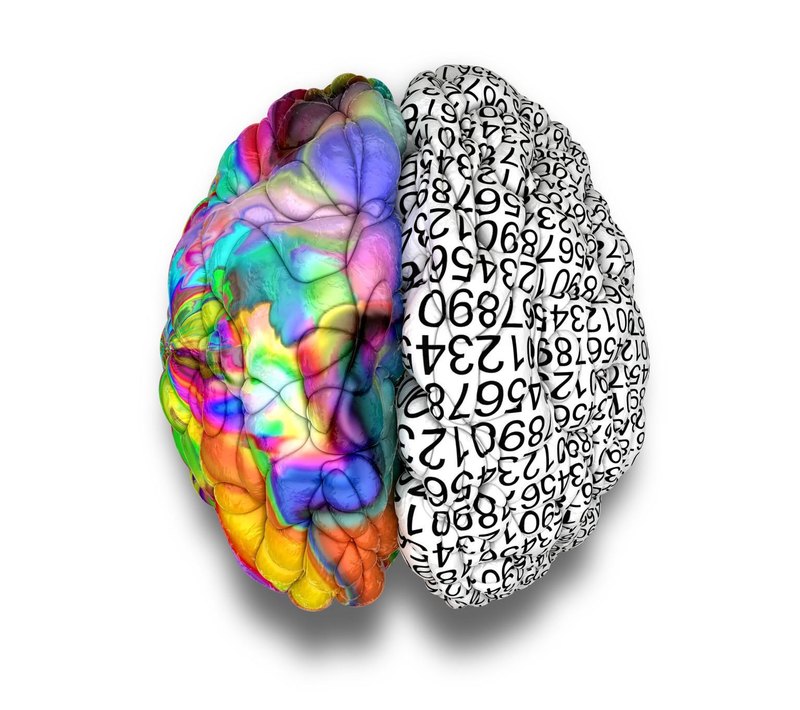
During the evolution of vertebrates, the left and right sides of the nervous system performed different functions. The advantages of this asymmetry, which we share with fish and frogs, lizards, birds and rats, are that such differentiation helps to carry out more complex functions. Why should top and bottom, left and right be the same? As we pointed out above, the brain stem and limbic system developed earlier than the cortex. Their asymmetry led to a difference in the structure and connections between the right and left hemispheres of the cerebral cortex. These structural differences lead to a distinct difference between their functions. The right hemisphere develops and functions most intensively in the first two to three years of life. The left begins to develop in the second year of life, and then both develop, alternately overtaking each other. The corpus callosum, a structure connecting both hemispheres, reaches its full development around the age of 25.
The general meaning of the difference can be illustrated at least by the fact that the columns of the cortex of the right hemisphere have more horizontal connections, as a result of which communication between different parts of the cortex of this hemisphere acquires greater multimodality. This discovery helps us understand why the right hemisphere is better at distinguishing contexts and better at grasping the big picture than the detail-oriented left hemisphere. In the left hemisphere, the speakers work more independently, are more isolated from each other, which allows the left hemisphere’s cortex to delve into the deeper essence of processes and phenomena, be more analytical, focus better on certain problems, closely monitor individual subjects and accumulate specific facts.
The streams of signals from the subcortical regions provide sensory data to both hemispheres, and this helps to understand why there is a difference between them. People often ask about the differences between the brains of men and women, so the following is a generalizing statement that puts both sexes in a good light. The female brain is characterized by greater integration, and women have a more massive corpus callosum connecting the right and left hemispheres. The male brain, so to speak, is more differentiated, more specialized. Different parts of a man’s brain, as a rule, work independently, without connection with other areas of it. These generalizations often make me shudder, but these are the data of objective science. However, in clinical work it is very important to see people as they are, and not as statistics prescribe them to be.
The features of the functioning of the left hemisphere can be easily remembered by solidifying the rule of three “l” and one “b”: linguistics, linearity, logic, and bookalism.
On the contrary, the right hemisphere is characterized by the following properties: non-verbal, holistic representations are formed in it, visual-spatial perception is characteristic of it, as well as a number of heterogeneous functions, including autobiographical memory, an integrated body map, the formation of undeveloped spontaneous emotions, sympathetic non-verbal reactions and alertness, as well as stress modulation. The right hemisphere, as many scientists believe, is responsible for mitigating the effects of distress and negative emotions and tends to distance itself from everything new and unfamiliar. The left hemisphere is responsible for more positive affects and controls exploratory behavior. Coordination of the work of the left and right hemispheres in the formation of general emotional tone is probably an important aspect of changing the affective profile under the influence of attentive awareness. As we have already seen, attentive awareness promotes exploratory behavior, which is manifested by a left-sided shift in cortical activity.
If the functions are separated from each other, then the brain can combine them, allowing for more complex and adaptive functions. This is how neural integration works. In this way, the complex systems of the brain and consciousness become more flexible, creating new combinations of functions. Having physically and functionally separated right and left hemispheres, we will be able to create more adaptive functions if we combine and integrate the separate functions of each hemisphere. So, I believe that creativity is born not in any one hemisphere, but as a result of the integration of their functions.
The left hemisphere can take on the role of a “narrator”, linguistically articulating a person’s current life story. However, the “content” of our autobiographical memory resides in the storages of the right hemisphere, and thus a complete verbal description of this content depends on the cooperation and integration of both hemispheres. The integration of the right and left hemispheres helps us to give meaning to our existence (more on this in the appendix, in the discussion of the laterality of the hemispheres).
Awareness of the totality of one’s own body sensations may require connecting the integrated body map in the right hemisphere with the activated lateral prefrontal cortex. In the course of mindful awareness, we often focus on various aspects of our bodily functions. This process requires the participation of not only interoception with the connection of the insula and the median prefrontal cortex, but also the involvement of the entire body map represented in the right hemisphere. If, in the process of practicing mindfulness, our mind is filled with the verbal narrative of the left hemisphere, this means that there is a powerful neural competition between the right hemisphere (body sensation) and the left (verbalized thoughts) for the limited resources of the focus of attention available at that moment. The work in the process of attentive awareness of the shift to focusing attention on the body leads to its functional shift from linguistically formed conceptual facts to non-verbal imagination and somatic sensations mediated by the right hemisphere. We find confirmation in the work of Lazar, who found an increase in the volume of the median prefrontal cortex and the insula cortex in the right hemisphere.
But if internal storytelling (even if it is wordless, in the form of witnessing awareness, or an internal observer) is indeed a function of the left hemisphere, then in this situation we should observe activation of the left prefrontal cortex (responsible for organizing attention with active narrative observation), as well as activation of the right prefrontal area (nonverbal reflection and metacognition mediated by the medial prefrontal cortex) and activation of the right insula— a representation of internal organs. These facts will help us to understand and synthetically combine the data on the left-sided shift and the exploratory response noted by Davidson and his colleagues with the Lazar data on the activation of the prefrontal cortex and the insula on the right. These arguments require empirical, experienced confirmation, which will allow them to be verified. However, this is an example of how we can, based on modern knowledge about the brain (lateralization of functions), ask verifiable questions about observed phenomena (attentive awareness) and general principles (integration of neural activity and a sense of well-being) in order to deepen our understanding of subjective and objective (neuronal)
life.
Source: Daniel Siegel “The Attentive Brain”
Photo: popmeh.ru
Don’t miss the most important science and health updates!
Subscribe to our newsletter and get the most important news straight to your inbox