Neurotransmitters are the language spoken by the brain
The cells of our body constantly communicate with each other, ensuring the smooth functioning of the whole organism. Billions of tiny messengers deliver messages that allow the cells to sound like a single harmonious orchestra. Two systems, the endocrine and the nervous system, claim to be the main conductors of this orchestra. In the case of the endocrine system, hormones play the role of information couriers. Through these chemicals, the glands communicate with each other according to a strict hierarchy, and also send orders to various cells of the body. But who plays the role of messengers in the nervous system? This function is performed by special molecules called neurotransmitters.
Chemistry of neurons: the history of the discovery of neurotransmitters
Until the beginning of the twentieth century, scientists were sure that the impulses that are transmitted from one nerve to another are exclusively electrical in nature. The nervous system seemed to researchers to be a kind of set of wires through which an electric current passes from the brain to the organs and back. Santiago Ramon y Cajal, a Spanish physiologist and one of the founders of modern neuroscience, was the first person whose work led to doubts about this theory. He found that the progress of the pulse along the processes of neurons is intermittent. This means that the signal traveling along the nerve is interrupted and then resumed.
In 1914, a pharmacologist from England, Henry Dale, discovered that injecting a special substance called acetylcholine into the mouse brain caused the same effects as mechanical stimulation of certain nerves, albeit for a very short time. A little later, in the 20s of the twentieth century, the German pharmacologist Otto Levy experimentally proved that during the passage of an impulse through nerve fibers, the electrical nature of the signal changes to chemical, and then back to electrical. Chemicals that act as intermediaries in the transmission of nerve impulses are called neurotransmitters.
Don’t miss the most important science and health updates!
Subscribe to our newsletter and get the most important news straight to your inbox
What are neurotransmitters and how do they differ from hormones?
Neurotransmitters (or neurotransmitters) are chemicals that transmit signals between two nerve cells or between neurons and other cells in the body. They affect many psychological and physiological functions of the body, affect mood, memory, learning ability and concentration, regulate sleep, appetite, vital signs such as heart rate, respiration, digestive features, etc. depend on them.
At the same time, neurotransmitters are often confused with hormones. This is not surprising, and not only because their regulatory functions are very similar: the fact is that many neurotransmitters have hormone substitutes. So, there is dopamine-hormone and dopamine-neurotransmitter, there is norepinephrine-neurotransmitter and norepinephrine-hormone, etc. Despite the fact that these substances have the same chemical formulas, they have different effects on the body. The main difference is that hormones are produced only in the endocrine glands, and the place of formation of neurotransmitters are exclusively neurons. Therefore, the effect of neurotransmitters is limited to the nervous system, and hormones act on the periphery and cannot enter the brain – there is an obstacle in their way in the form of a blood-brain barrier.
The differences between hormones and neurotransmitters with the same chemical formula can be considered using the example of norepinephrine. Norepinephrine is a hormone produced in the adrenal glands during stress, its effect is similar to adrenaline, but it has a more pronounced vasoconstrictive effect and has less effect on the heart rate, has a less significant effect on the smooth muscles of the intestine, etc. That is, the sphere of influence of norepinephrine hormone is the internal organs – it participates in controlling the body’s response to stress.
At the same time, norepinephrine, a neurotransmitter, “reigns” in the brain: in stressful situations, it is responsible for the feeling of excitement and pleasure from risk, increasing aggression and reducing anxiety. In its more “peaceful” form, it helps to better remember information during learning.
The principle of operation of neurotransmitters
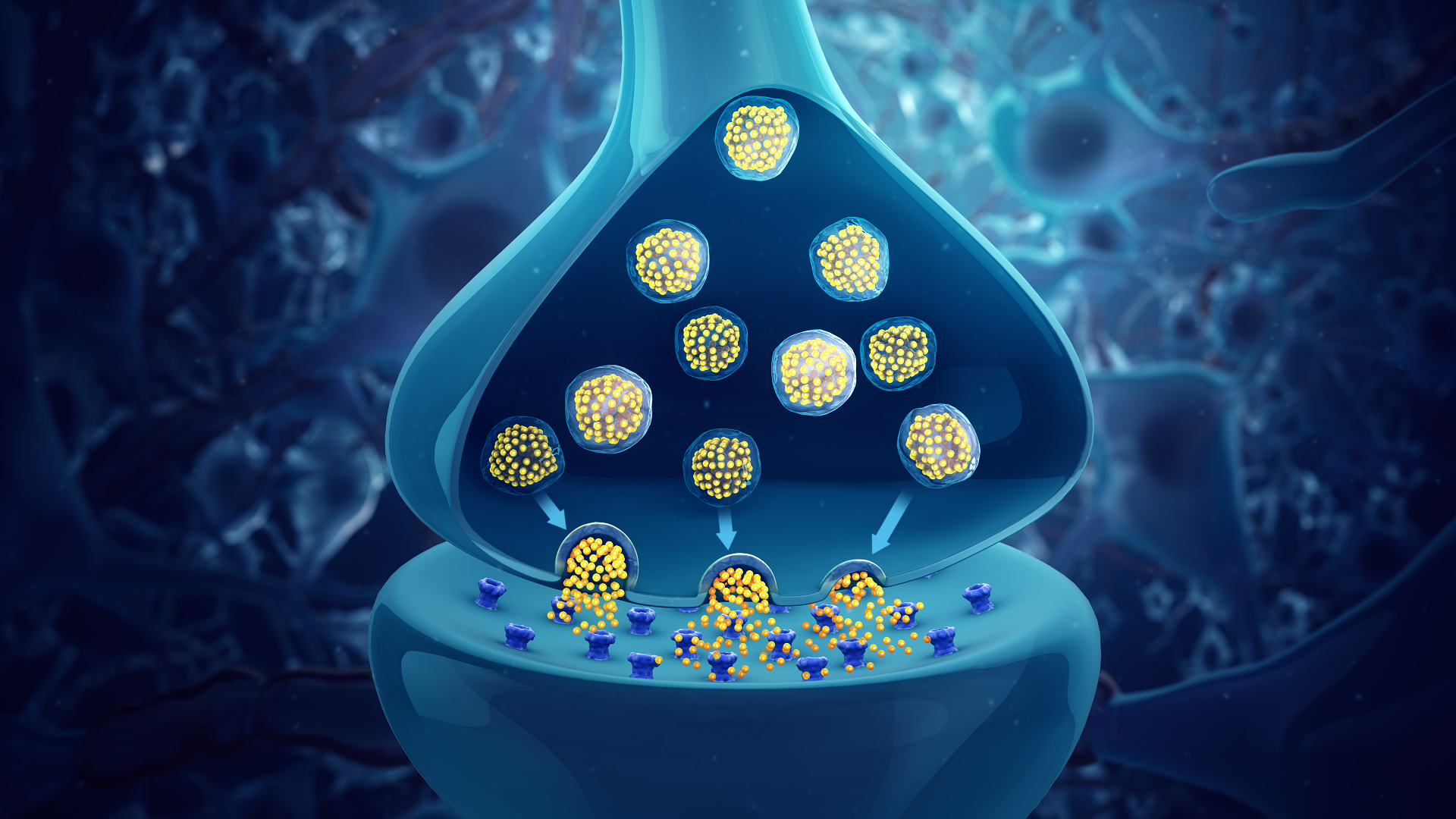
At what point does a nerve impulse “lose” its electrical nature and “switch” to a chemical one? This happens when a signal coming from the body of a nerve cell along a long process – the axon – reaches a site called a synapse. A synapse is a point of contact between the end of one process and the beginning of another, or the cell membrane to which the signal needs to be delivered. There is a space 10-50 nm wide between them, which is called the synaptic cleft.
The terminal section of the process through which the signal came is called presynaptic. It is in it that neurotransmitters are synthesized: they are contained in small vesicle bubbles. Their release into the synaptic cleft occurs in response to reaching a threshold action potential, that is, the nerve impulse must be characterized by a certain intensity.
Once released, the neurotransmitter enters the synaptic cleft and contacts the receptors on the surface of the process of the “receiving side” – the postsynaptic membrane. Activation of the receptors gives rise to the birth of a new nerve impulse, which continues its path (if there is contact between neurons) or causes the desired effect in the cell to which the signal was sent. However, the chemical signal can also suppress the nerve impulse at the postsynaptic termination.: it depends on what kind of work neurotransmitters do – excite or inhibit.
After the signal has been transmitted from the end of one nerve process to another, the neurotransmitter molecules remaining in the gap are either rapidly destroyed or “pulled” into the presynaptic terminal with the help of special pump proteins. This principle is called the neurotransmitter reuptake principle, and it is used in the creation of certain drugs. Thus, the effect of many antidepressants is based on blocking the reuptake of the neurotransmitter serotonin, responsible for good mood. As a result, serotonin stays in the synaptic cleft longer, exerting the desired effect.
What are neurotransmitters and how do they affect humans?
According to the effect that a neurotransmitter has on the “receiving” nerve ending, they are divided into excitatory – under their influence, the action potential increases and a new impulse is generated, and inhibitory – blocking the achievement of the action potential in the postsynaptic nerve ending. Some neurotransmitters, such as dopamine and acetylcholine, can have both stimulating and suppressive effects, depending on the type of receptors on the postsynaptic membrane. Next, we will talk about several neurotransmitters that have a powerful impact on various aspects of human life, both physiological and psychological.
Dopamine is called the neurotransmitter of winners, and scientists characterize it as one of the key factors of internal reinforcement. His education helps to remember positive experiences, for example, when a person tastes delicious food, receives praise, has sex, and achieves a goal. The release of dopamine is accompanied by a feeling of euphoria: the brain remembers this and motivates a person to re-receive positive experiences. Dopamine plays an important role in learning processes, and it is also involved in the regulation of muscle function. When dopamine production is disrupted, so-called dopamine diseases develop: these include, first of all, Parkinson’s disease and schizophrenia.
Acetylcholine is the first neurotransmitter discovered by scientists. This substance plays a crucial role in the transmission of impulses in the autonomic nervous system, which regulates the work of internal organs. When it is released, the heart rate decreases, and digestion, on the contrary, is activated, the tone of the smooth muscles of the bronchi increases, etc. Acetylcholine, which is produced in the neurons of the brain, participates in the regulation of motor activity, as well as processes related to memory and learning. Its deficiency plays an important role in the development of neurodegenerative diseases, primarily Alzheimer’s disease.
Serotonin is one of the most important regulators of human mood. When it is released, neurons in brain regions associated with negative emotions such as resentment, disappointment, and sadness are inhibited. Therefore, serotonin deficiency is fraught with the development of depressive states, and the treatment of depression is aimed at restoring the synthesis of this neurotransmitter. Serotonin is also involved in reducing pain sensitivity, ensuring normal sleep, regulating appetite, memory, and learning.
Glutamate is the main excitatory neurotransmitter of the nervous system, and the rate of transmission of impulses between neurons and target cells depends on its presence. It plays an important role in the early stages of the formation of brain activity, regulates the processes of learning and memorization. An excess of glutamate leads to the death of nerve cells, and a deficiency leads to a decrease in brain activity and chronic fatigue. An imbalance of this neurotransmitter is observed in many neurodegenerative diseases, including Parkinson’s and Alzheimer’s diseases.
Conclusion
There are many nerve endings attached to each neuron: they all strive to convey their “message” to the nerve cell. The behavior of a neuron is the sum of the interaction of these messages, and our behavior is the totality of a complex interaction between billions of neurons. Therefore, studying the mechanism of action of neurotransmitters is the key to understanding the language spoken by neurons and understanding the extreme complexity and beauty of the brain’s communication system.
Published
June, 2024
Duration of reading
About 3-4 minutes
Category
The brain and nervous system
Share

