Almost immortal. What a man can learn from a naked digger
How naked apes (humans) are similar to naked shrews (Crotocrys), or why the ape is descended from man.

Earlier we found out that amazing African animals – naked mammals – have switched off ageing by applying a clever biological trick. They have so slowed down the process of their individual development that they remain in the state of small cubs for a very long time (decades at least). That’s why they look so much like newborn baby rats. And cubs don’t age, because everything has to start in this life in its own time. Including aging. The crafty earthworms have so rearranged their internal biological clock that it never reaches the ‘OK. You’re an adult now. Start aging.’
Earthworms have been able to deal with aging so boldly because they are true evolutionary innovators. Their numerous and highly organised colonies are so stable that these beasts can afford to slow down their evolution a little. And since aging is a tool for accelerating evolution, the resourceful African rodents can do without it. That is, not grow old.
But speaking of ‘evolutionary champions’, we cannot avoid one species of animals, even more successful than mammals, and especially interesting for us. This species has invented something that no longer needs evolution at all. Its representatives are found in every corner of the globe. They withstand the bitter frosts of the Arctic and Antarctic, the heat of the most terrible deserts. They can be found in the depths of the ocean and even in near space.
It must be said that this is a very young species. If measured by the evolutionary clock, it finally formed only a few seconds ago (scientists argue when exactly this happened, but it is unlikely that it is more than 200,000 years old). And in that time, or rather, just in the last thousand years, it has managed to spread across the planet like this. You’ve probably already guessed which animals we’re talking about. It’s Homo Sapiens, that’s you and me.
What was it that man invented in his development? What made him the evolutionary champion? In my opinion, three things: brains, speech and… grandmothers (and grandfathers).
You know what our most important skill is, what makes us different from other animals? I mean, we have many differences: we are upright, we have a sore thumb on our hand, so we can hold tools in our hands, we can throw objects more accurately than anyone else, and in general, fine motor skills are very good! But, in my opinion, the main peculiarity and uniqueness of a human being is the ability to work with information. And it is this ability that has provided us with such an amazing adaptability to any conditions of existence.
Perhaps this statement needs clarification. As I have already mentioned many times, from the evolutionary point of view, the meaning of life of any living organism is to transmit information. It must pass its genetic information to the next generation. That is, to reproduce, to bring offspring. And by and large, the transferred genes contain all the information necessary for the life of the said offspring. Even the most complex animal behaviour is encoded in their genes. If you take away a newborn beaver from its mother, take it out, raise it and let it go free, it will certainly find some stream in the forest, try to block it with a dam to build a cosy hut with an underwater entrance. Alone, of course, he will not do too well, but nevertheless he can do it all simply on the basis of genes contained in the cells of his body.
And humans? Our main difference even from our closest relatives – great apes – is a more developed brain. And this brain is constantly working. That is, it receives and analyses data, creating new information. In principle, the brains of other animals are busy doing the same thing, but this is the case when quantity turns to quality. The powerful brain of Homo Sapiens produces so much information that it would be a good idea to share it with its relatives. And that’s where we got lucky once again. A very delicate device for transmitting data – our vocal cords – was invented. And the result was human speech. (Don’t get me wrong, animals can communicate too, but on a completely different, primitive level.) And that’s when we won the evolutionary race. Because unlike all other animals, we can transmit huge amounts of information to other generations not only in the form of genes, DNA, but simply in the form of words, through speech. And this gives us a tremendous advantage in terms of survival. Let me explain by example: here is a mountain, and a cave lion has settled behind the mountain. You can’t go there, he’ll eat you.
We have to somehow adapt to these new conditions. How would ordinary animals solve this problem? It would take millions of years for the unfortunate ones to develop a mutation that makes them fear, say, the silhouette of a mountain. The mutation would then take hold in subsequent generations, and the lion would stop eating animals of that species.
How does a man endowed with brains and speech solve this problem? When he sees a lion (or its tracks, which is even more convenient), he simply says to the others: don’t go behind this mountain, they will eat you. Bingo! No need to wait for millions of years of evolution, the problem is solved not just within a generation, but simply within a day. Can you imagine how much more efficient it is to adapt to new conditions like this?
Or let’s say it got colder. Common animals have an evolutionary competition to see who gets the mutation that allows them to have fluffier fur. The process takes many millennia.
And we have one clever person who thinks of wrapping himself in the skin of a dead animal and, of course, tells the rest of us how great it is. Problem solved, no need for millions of years of evolution.
This is great in itself, but it is even more interesting if we ask ourselves: who can pass on information to the next generations? In animals, only the parents. Because information is transmitted only with genes, and we get them from our parents. In humans, not necessarily. We can be terribly useful to our species, even if we’ve lost the ability to reproduce. Because you can explain to young idiots that there’s a cave lion behind that mountain in your old age. An older, experienced teacher is somehow more trustworthy and authoritative.
The reasoning is rather banal, but it has an important biological consequence. In short, we humans are allowed to live, even after we are no longer able to reproduce because of age. This is best seen in the following graphs. Look, here are two curves showing the relationship between survival (red) and ability to reproduce (blue) in our close relative, the baboon.
Don’t miss the most important science and health updates!
Subscribe to our newsletter and get the most important news straight to your inbox
Published
June, 2024
Duration of reading
About 4-5 minutes
Category
Epigenetics
Share


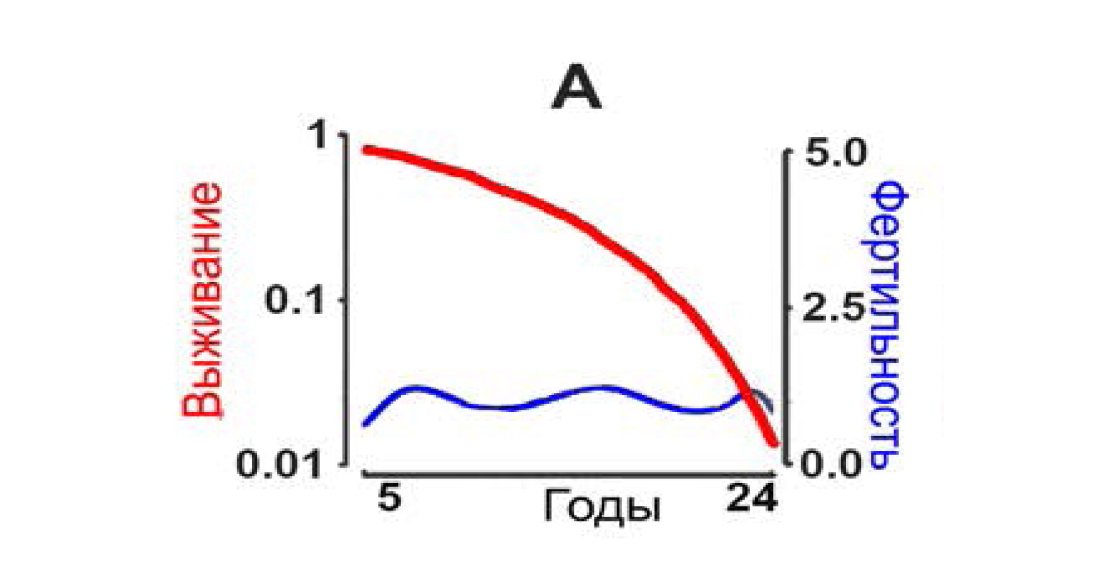
You can see that by the age of 20, baboons are already almost completely extinct from old age, but can still reproduce.
And this is how these curves look for modern humans (data on women in Japan for 2009).
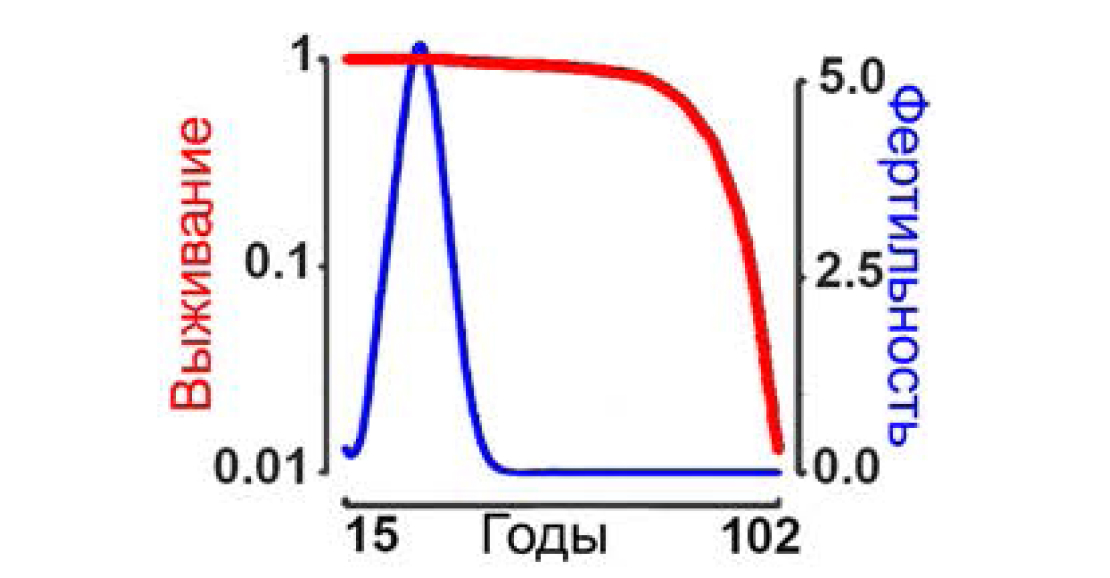
Do you see the difference? By the age of 40 or so, we lose the ability to reproduce, the so-called menopause sets in (primarily for women, of course). But after that we live for decades more! Why? What is the biological meaning of individuals who can no longer procreate? I gave the answer above. We have the institution of grandparents who can pass on their accumulated experience to their descendants not only with their DNA, but also simply with speech.
And that’s why human aging is so much slower compared to animals. Simply because we have something to do at 40, 50 and 70. And a baboon, no matter how clever and experienced he is, will simply not be able to teach anything sensible to the young. There is no tool to transmit information, and young baboons do not have enough brains to accept it.
Whoa. What are we getting to here? Human aging is retarded? Yeah, look at the graphs. We live an abnormally long time even compared to our very close relatives, chimpanzees and gorillas. No monkey, no matter how well cared for, is older than 50 or 60 years. And people even before the invention of modern medicine easily lived to 80, and, they say, to 100.
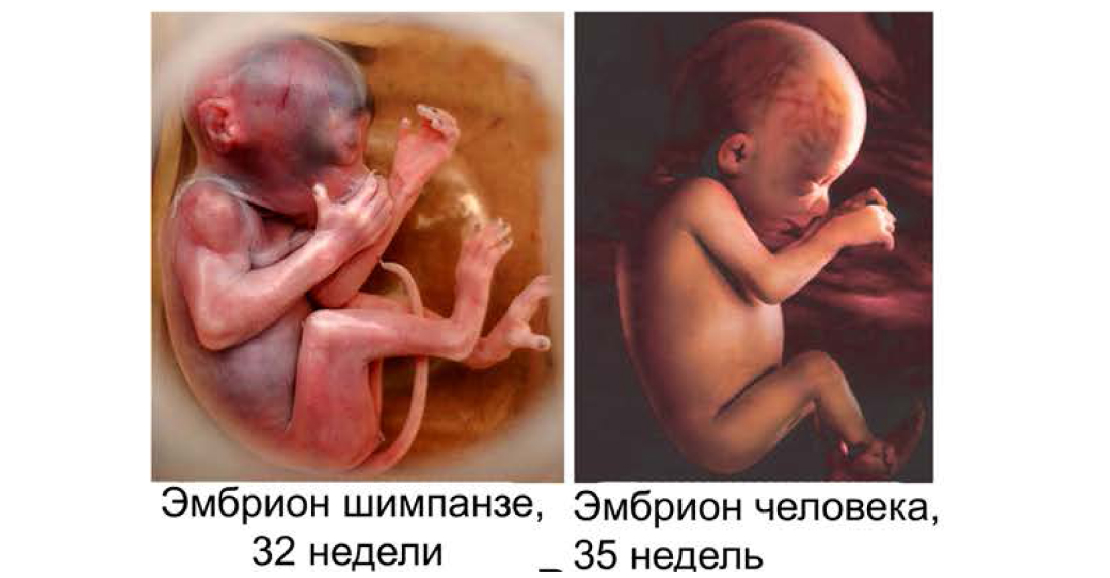
How did we get to that point? The humour is that we seem to have done it in the same way as… naked diggers. With neoteny. I’ll allow myself a few illustrations.
Consider this. At the beginning of our journey, or rather, in the womb, we are virtually indistinguishable from apes:
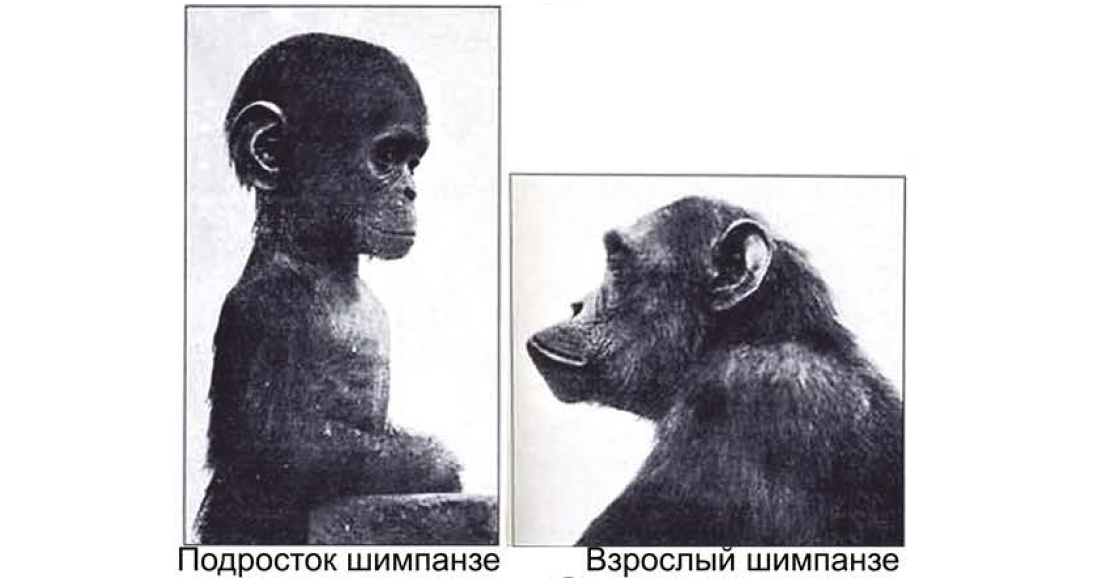
And after birth, baby monkeys look a lot like us humans. Below is a classic picture showing the difference between a baby chimpanzee and an adult chimpanzee:
The similarities between humans and apes are especially obvious when you look at the structure of the skull:
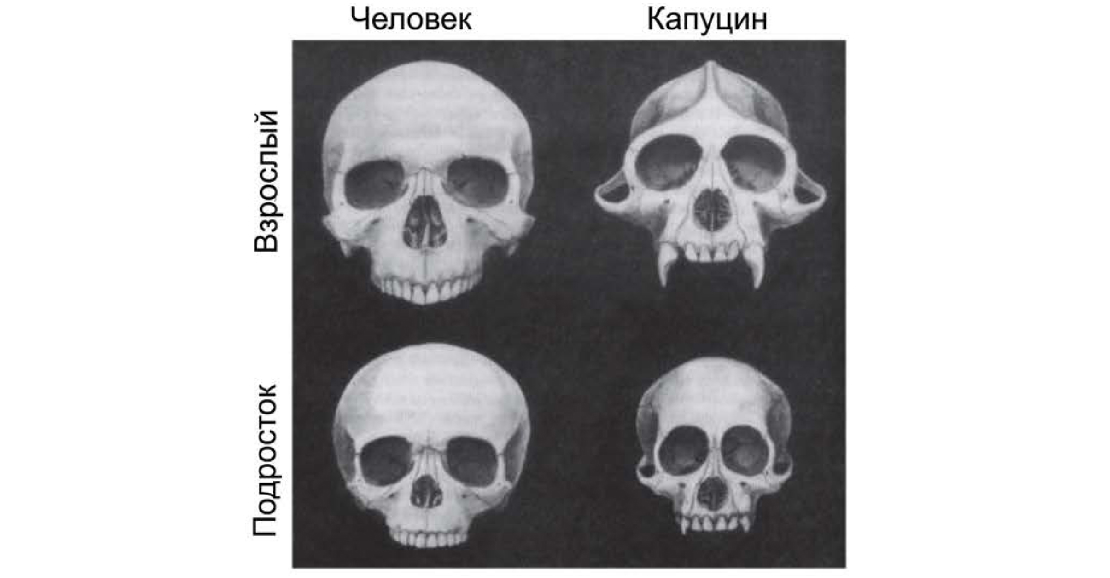
The photo above shows the skulls of humans and monkeys (in this case capuchins) in childhood and after adulthood. Here it is quite obvious that humans are most similar to baby monkeys in their structure. All pictures are from the article (Skulachev et al, (2017), Physiological reviews, 97, pp 699-720).
That is, it turns out that we, just like the naked diggers, slowed down our development and more or less ‘froze’ at the stage of a child, well, or adolescent. And that means that humans are also (like diggers) an example of neoteny. (It is funny, but in some way it is not man who descended from monkey, but on the contrary, all monkeys are ‘human’ in childhood, but quickly pass this stage and turn into normal animals). Of course, we are not the first to notice this. The similarity of embryos was pointed out by Charles Darwin. And the fact of neoteny was well described by the English anthropologist Bolk in the 1920s. He counted in humans more than two dozen signs characteristic of small apes. By the way, these traits include curiosity and the ability to learn. I can personally testify that some academicians of the Russian Academy of Sciences even after 80 years of age retain an inquisitive mind and actively explore the world around them no worse than the most advanced baby monkeys. True, they use for this purpose somewhat more advanced methods from the field of molecular biology and biochemistry, but the essence does not change much.
A few years ago, a scientific paper was published by an international team led by a remarkable young scientist Philip Haitovich (probably, you can call him a Russian scientist, after all, we are classmates of his classmates at the biophage of Moscow State University, but the work was done by one of his foreign laboratories, the one in Shanghai). Philip and his colleagues managed to show directly at the level of gene work that our brains function in ‘child mode’ for an abnormally long time (compared to other animals). We are talking about this article, it is very difficult to understand even by professionals, so it will be easier to listen to a short story by Philip Haitovich on YouTube.
So, what do we get? Man is a neotenic, i.e. ‘stuck in childhood’ animal. Just like the naked digger. And as a result, his aging is also delayed. According to the latest WHO guidelines, a person is considered young until the age of 45. And this I can confirm personally: I am just about to turn 45, and I do not consider myself old at all. But our closest relative – the chimpanzee – at 45 looks like a profound old man, they rarely live to such an advanced age.
So compared to the apes, something in us has slowed down. Some clock, some mechanism is not ticking as fast as it could. What is it? For me, the answer is obvious: the ageing programme. We have it too. And we’ve already slowed it down a lot in the course of our evolution. That’s great in itself, but I’m sure we can slow it down even more by employing a favourite trick of mankind, which has long been a substitute for our turtle-slow biological evolution. This trick is called science and technological progress.
Author: Maxim Skulachev, Forbes.
Source
Journal Forbes. Article: Almost immortal: what a person can learn from a naked digger