Thyroid gland: functions and diseases
Olga Smirnova, Doctor of Biological Sciences, Professor at the Department of Human and Animal Physiology and Head of the Laboratory of Endocrinology at the Faculty of Biology of Lomonosov Moscow State University, told “Postnauka” about how the thyroid gland is organised, what functions it performs and why one should not consume too much iodine.

Often, if a person, especially a woman, complains of feeling unwell, malaise, lethargy and lack of energy, they are suggested to have their thyroid gland checked. This is because such symptoms may indicate that the thyroid gland is not working properly. Such a condition is called hypothyroidism. No one knows why women have thyroid problems much more often than men. Most likely, it is due to the activity of female sex hormones. But the exact mechanisms of these processes are still unknown to us.
Don’t miss the most important science and health updates!
Subscribe to our newsletter and get the most important news straight to your inbox
Thyroid study
The thyroid gland is present in one form or another in all vertebrates, although not all are organised into a gland. In the course of evolution in different species, the function and structure of the thyroid has changed somewhat. For example, in frogs, thyroid hormone stimulates the transformation of the tadpole into a frog, that is, it is responsible for the differentiation of different parts of the body, as a result of which the tadpole and becomes a frog. In mammals, thyroid function affects primarily the development of the brain during the initial period of embryonic maturation and, in adulthood, its function. From lower vertebrates to higher vertebrates, the functions have been modified, but not dramatically.
In general, the study of the thyroid gland began at the end of the XIX century. This was due to observations indicating that the inhabitants of mountainous areas who drank water that did not contain iodine, there was a shortage of it, resulting in an increasing number of people suffering from cretinism. Cretinism is a disease associated with the fact that during embryogenesis, in the process of intrauterine development, thyroid hormone was not synthesised, due to which the brain did not develop well. This was particularly noticeable in the Alpine regions, in Switzerland and neighbouring areas. And since cretinism is a serious disease, it was actively studied and thus it was discovered that for the normal functioning of the thyroid gland, iodine must be supplied with food.
Structure and work of the thyroid gland
The thyroid gland consists of follicles, which are like bubbles that accumulate synthesised thyroid hormone in a protein-bound state. When more of these hormones are needed in the blood, some of the fluid inside the follicles, which contains thyroid hormones (this fluid is called colloid), is captured by the cells of the follicle membrane, the protein is broken down, and the hormone enters the bloodstream. If the thyroid gland is working too intensively, there will be an excessive number of such follicles, and they will produce more hormones. And if the thyroid gland is not working sufficiently, the follicles swell, become large, and contain a lot of colloid, because few hormones are produced and few enter the bloodstream.
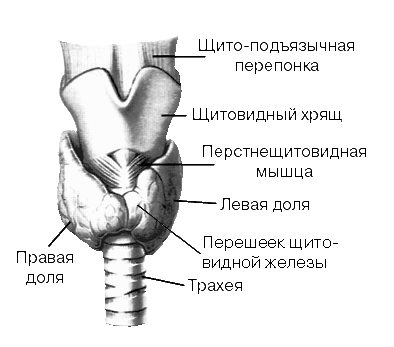
Structure of the thyroid gland // dic.academic.ru
Both hyperthyroidism and hypothyroidism often cause goitre, an enlargement of the thyroid gland that is visible to the naked eye. But the causes of this goitre vary: in the case of insufficiency, it occurs because the follicles fill with colloid and visible growth of the thyroid gland occurs, and in hyperthyroidism, it occurs due to a large number of small follicles, which contain little colloid. There is also the concept of thyroid nodules, which are simply a large number of follicles. They can be diffuse, i.e. located throughout the thyroid gland, or, conversely, in groups or clusters.
Published
July, 2024
Duration of reading
About 3 or 4 minutes
Category
Endocrine system
Share


Thyroid function
The thyroid gland is not only responsible for the production of a number of hormones, but is also regulated by them and has a direct, very serious impact on various types of tissues. If during pregnancy the foetus or a newborn child had problems with thyroid function, not enough iodine was produced, it can greatly affect mental abilities, up to cretinism. In adults, thyroid hormone affects energy metabolism and the nervous system. If the thyroid produces an overabundance of hormones, then there is overexcitability, and if, on the contrary, they are few, then a person suffers from lethargy and apathy.
The work of the thyroid gland depends on whether iodine enters our body. It is needed because the thyroid hormone contains iodine atoms, which we must receive with food. Both excess and deficiency of iodine are equally harmful, so there should be certain norms of iodine intake. In Russia they used to be somehow regulated by the state, but now this is not the case, so quite often there are diseases associated not only with iodine deficiency, but also with iodine overabundance. We often see adverts for iodine-containing preparations, and people take them because they think it is useful. But in fact it is a two-edged sword.
Thyroid diseases
Among the most common thyroid disorders are hyperthyroidism and hypothyroidism, which are associated with an overabundance or deficiency of thyroid hormones. In hyperthyroidism, too much thyroid hormone is produced, resulting in a number of characteristic symptoms. The most well-known is exophthalmos, which is exophthalmos, as well as hand tremors and increased heartbeat. Others are excessive excitement, insomnia, hyperactivity, irritability, and weight loss. If you take too much iodine, these symptoms just might appear.
The causes that can lead to thyroid disease are many. For example, the same hyperthyroidism may be associated with the emergence of antibodies that mimic the action of the hormone that stimulates thyroid function – thyroid hormone. That is, the thyroid because of this works not under the influence of the pituitary gland – it just has thyroid hormone, which is responsible for stimulating the thyroid gland – and under the influence of antibodies that are very similar to it.
The main thyroid diseases in adulthood (with the exception of cretinism occurring in utero) are autoimmune in nature. By the way, the female immune system is more prone to such diseases than the male. Hyperthyroidism and hypothyroidism are associated with the production of antibodies to various proteins of the thyroid gland, and therefore women suffer more often thyroid, as they have autoimmune processes occur more often. That is, the cause of pathologies is not in the direct influence of female sex hormones on the thyroid gland, but in their influence on the immune system: due to this it works more intensively, antibodies are produced to their own proteins, including thyroid proteins. These antibodies can cause both hypofunction and hyperfunction of the thyroid. In addition, genetic mutations can also be the cause of thyroid disorders. They can occur in adulthood in individual cells, but can also be inherited, although this is quite rare.
There are many such causes, but they have the same result: thyroid disorder. To find out for sure, it is necessary to do a number of analyses. And the treatment of the disease largely depends precisely on the causes. Among the diseases of the thyroid gland there is also cancer, but, as a rule, it is quite a favourable current disease. Most often it is not cancer of the cells that produce thyroid hormones, but cancer of the cells that produce another hormone – calcitonin. This is the most common form of thyroid cancer, but any thyroid cancer is fairly easy to treat, and in most cases people live quite a long time or recover. So thyroid cancer is not particularly dangerous compared to other cancers.
Treatment and research of thyroid diseases
The treatment of most thyroid diseases has long been known. Hypothyroidism is treated by administering hormones, i.e. taking pills. Here everything depends on the correct dose. The patient should be taught to listen to his sensations, how much he is under-excited or hyperexcited. If the dose of the drug is too large, then symptoms of hyperthyroidism will appear, and if insufficient, hypothyroidism will persist.
Hyperthyroidism is treated both medically and surgically. But the fact is that after the removal of thyroid nodules that produce large amounts of hormones, insufficiency occurs. This is not always due to the fact that a large area of the thyroid gland is removed. In recent years, it has become clear: it may be due to the fact that the proteins that are in the follicles, during the operation come into the blood, and the immune system, not familiar with these proteins, begins to produce antibodies to them. That is, the surgery itself can provoke the process of autoimmune attack on the thyroid gland and cause hypothyroidism. Due to these findings, surgical treatment is now used much less frequently, and other methods are used to reduce thyroid function.
Symptoms of thyroid disorders
There are quite a few symptoms that could signal thyroid problems. But the trouble is that they can also refer to other diseases, so without tests it is impossible to say for sure whether the health problems are the result of thyroid insufficiency or hyperfunction. In hyperfunction, the characteristic signs are tremor (trembling of the hands), tachycardia (disturbance of the heartbeat). In women, there are specific triggers to thyroid disease, such as pregnancy or stress leading to hyperthyroidism, resulting in the signs listed above.
Hypothyroidism is mainly manifested by lethargy and apathy. The worse the thyroid works, the greater this lethargy. As a consequence, patients are reluctant to even go to doctors. Mental activity decreases, drowsiness appears, weight gain. But, as mentioned above, this does not necessarily indicate problems with the thyroid, there are other diseases with similar symptoms, and without analyses you can not say anything for sure. Therefore, hypothyroidism is more difficult to diagnose, while the symptoms of hyperthyroidism – tachycardia and tremor – are quite definite. But also in some cases people with such symptoms go first to cardiologists, who can sometimes start treating the heart, whereas the root cause is not in the heart, but in the thyroid gland. In hypothyroidism, on the contrary, the heartbeat is reduced and the blood pressure drops, which also leads to weakness.