It is clear why doctors and biologists are so actively trying to reveal the cell stem secrets: if we would be able to control those cells, a possibility of growing new organs instead of infected ones, suppress various congenital pathologies in the foetus and lastly even decelerate aging.
The most promising in this sense are the embryonic stem cells, which not only can divide for a very, very, very, almost infinitely long time, but also have so-called pluripotency, that is, they can produce a cell of absolutely any other type.
Until recently, the “almighty” stem cells could only be obtained from embryos, and this had left researchers with loads of legal difficulties. But then it turned out that mature, differentiated cells, such as, connective tissue fibroblasts,
can be converted to a stem state.
The role of fibroblasts is to synthesise collagen and elastin proteins, as well as other molecules, which make up connective tissue. However, if some special proteins are added to fibroblasts that specifically change the activity of genes in cells, fibroblasts will literally turn into childhood – they will begin to divide endlessly and can be programmed to transform into, for example, muscle cells or skin epithelial cells. Such artificial stem cells are called induced pluripotent, and they are almost indistinguishable from embryonic stem cells.
Nevertheless, many do not trust artificial stem cells very much. Although they are easy to work with in the laboratory, there is a chance that in a living organism they can turn into malignant cells, due to molecular interference in the genetic backstage. Therefore, various researchers are currently looking for a way to make them as safe as possible, learning to turn mature cells into stem cells so as to minimally interfere with genetic programs. (Although it is worth mentioning that many biologists believe that the differences between artificial stem cells and natural ones are insignificant.)
The technique described by researchers from the
National University of Singapore described in
PNAS journal, does not require any reprogramming. According to the authors, mature cells are able turn into stem cells themselves provided that they are properly restricted in space.
Fibroblasts were placed on a rectangular platform, where they divided, grew, and became rectangular themselves. But then there were even more of them, and they, climbing on top of each other, gradually formed a cellular ball. When the genetic activity of the cells in such balls was checked, it turned out that the genes that usually work in mature fibroblasts were switched off, and the genes that usually work in pluripotent stem cells were switched on. And then such cells growing on rectangular platforms were quite successfully transformed into cells of a different type (although some became fibroblasts again).
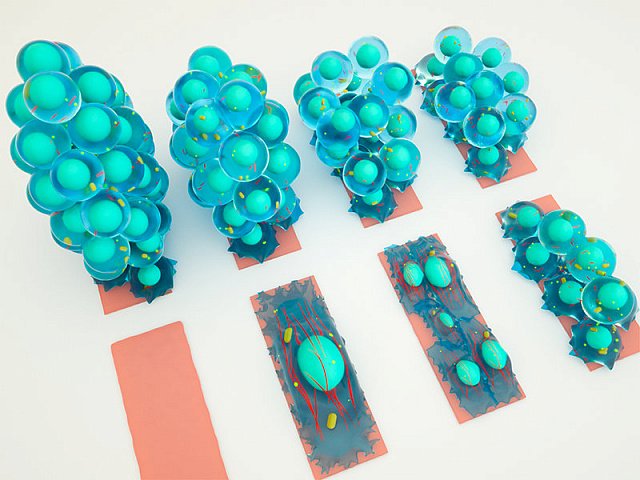
Whether such a geometric method will be effective enough to obtain safe stem cells only further studies will tell (we would like to emphasise once again just in case that in this study everything worked out without adding any special molecular regulators to the cells).
However, the results obtained indicate once again that while studying the behavior of cells, we must take into account not only the biochemical signals they receive from the environment, but also the form of this environment itself. In other words, consider the physical constraints within which cells have to exist.
According to the authors of the work, mechanical forces play a major role both during embryonic development and during wound healing: in a damaged area cells end up in a different geometry, which prompts them to activate the stem program and heal the injury more quickly.
Here it is worth remembering that we already wrote about the
importance of geometry in the life of cells. Two years ago in PNAS once again there was an article where it was written that Cells, when ingesting particles from the environment, pay attention to the shape of what they eat, preferring to eat things that are elongated and round.
Author: Kirill Stasyevetch
Source: Nauka i zhizn’ (In Russian)
Don’t miss the most important science and health updates!
Subscribe to our newsletter and get the most important news straight to your inbox